Every automation advance of the last century looked, at first, like it would replace human thinking. Adaptive cruise control did. Spreadsheets did. AI is the latest in that line, and on the surface it looks like the biggest threat yet. The people who came out ahead in every one of those earlier transitions did the same thing: they redesigned the work around the new tool. AI is no different. The trick is the workflow.
The atrophy framing
Joshua Miller, a Master Certified Executive Coach, calls this failure mode ATROPHY — automation dependence, thinking reduction, reasoning decline, ownership erosion, pattern reliance, weakened human judgment, and eventual yielding to the machine. It is the same arc you saw with auto-braking on a car: the driver grows less alert, then dependent. AI will do that to a knowledge worker who treats it as the answer machine instead of one piece of a workflow they own.
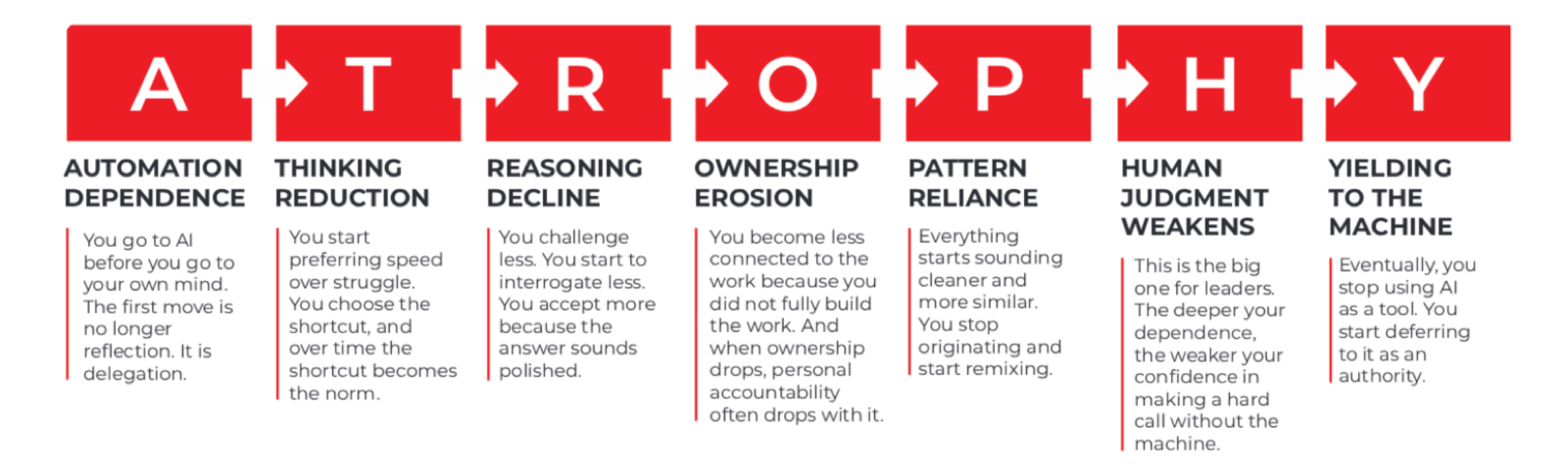
Figure 1. The ATROPHY failure mode, courtesy Joshua Miller, The Assessment I Had to Build (LinkedIn). Used here to frame the risk; the workflow design below is what avoids it.
The same conversation, fifty years apart
In the late 1960s and early 1970s my father was building one of the first design-simulation systems for industrial engineering. The criticism he got is recognizable today: this will kill how engineers think. He worked through it by drawing a clean line. Let the computer do the repetitive, mundane part of thinking faster than a human can, so the human can spend that returned time in the creative space, where the actual problem gets solved. He had two ways of saying it. The short version was:
“Computers are smart. People are clever.”
The long version came in a talk:
“When you build software, the idea is to enhance the creativity of the person using it. What you are faced with when you run a project is to have a tool that will model reality as closely as possible to allow you to anticipate, yet be flexible enough to respond to the kind of changes that get put on a project on a day-to-day basis.”
AI is our generation’s version of that 1970s argument.
Data, information, insight
A client put it best last year. He drew a three-step ladder: data, information, insight. Data is what the program generates as it runs. Information is what survives synthesis. Insight is what changes a decision. His point was that no one is rewarded for collecting data. They are rewarded for the call they made on Tuesday morning. AI is the first real lever we have had on that ladder in thirty-six years.
He paired it with a second image: the force multiplier. The Marine Corps trains one Marine to do the work of ten Army infantrymen — same body weight, different load-out and training. AI can do the same for a project manager or a portfolio leader. One person, with a workflow built around the right tools, can produce the insight a team of ten used to produce, and at higher quality, because the synthesis is consistent rather than dependent on who was in the room.
The trick is the workflow
The workflow is the product. The model is one component. Picking ChatGPT versus Claude versus Gemini is a five-minute decision. Designing the collect-and-synthesize loop the model sits inside is the actual work, and it is where the return shows up.
A workflow has three layers. A collection layer that pulls structured inputs (schedules, costs, risks) and unstructured ones (meeting transcripts, status notes) from the program. A synthesis layer where the model does what used to take hours of human reading. A human iteration layer where the PM owns the call. The PM still has to read the output and push back where it misses. That is the layer the atrophy curve eats if you let it, and the workflow protects it by making the iteration step visible and non-skippable.
What we are doing at lateralworks
Every artifact we produce runs through that three-layer pattern. The Weekly Schedule Refresh pulls six schedule extracts plus the pull-in meeting transcript and turns them into a written report. The portfolio model loads constraints, ranks projects, and gates the line between funded and deferred. The board summary pulls trend data and meeting transcript signal into one read. None of these existed as one-person jobs five years ago. They do now.
We call the product fastProjectAI. The “fast” is the data-to-insight step compressed from a week to an afternoon. A board read that used to require ten hours across three people now requires two hours from one. The PM is still the one in the room, still the one who has to defend the call. The workflow returns the time. The PM spends it where my father would have wanted them to spend it: in the creative space, on the problems that matter.
What this generation gets to do
My father did not live to see this. He would have recognized it instantly. The 1970s argument and the 2026 argument are the same argument, and his shorter version of it still holds: computers are smart, people are clever. The workflow is how you get both. Build the tool to enhance the creativity of the person using it. The people who figure that out spend the returned time well. The people who don’t, atrophy.