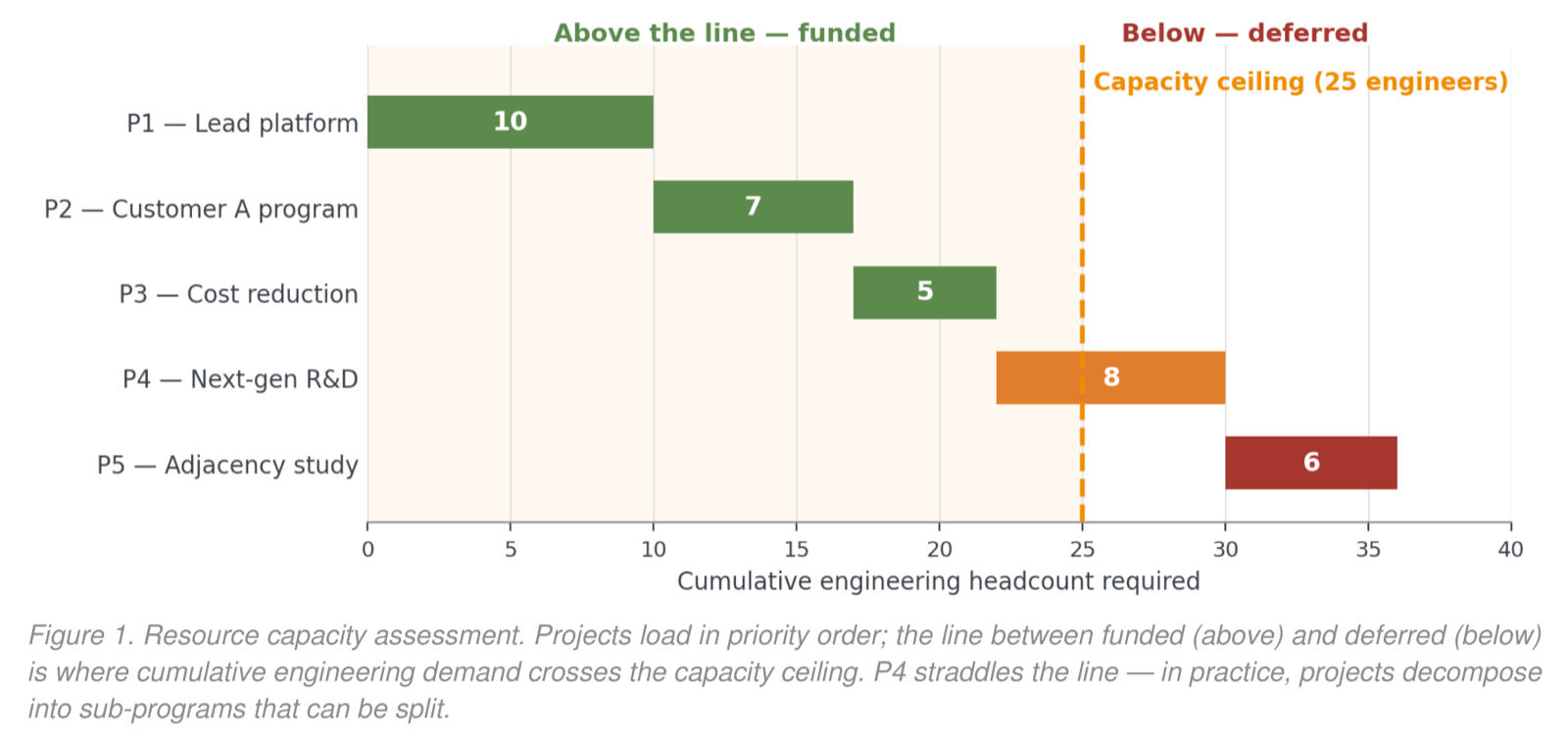
Figure 1. Resource capacity assessment. Projects load in priority order; the line between funded (above) and deferred (below) is where cumulative engineering demand crosses the capacity ceiling.
Why projects start late
Late delivery is a systems problem, not a person problem. The same structural causes recur across programs regardless of industry or size — the previous late project ties up the resources earmarked for the next one, priorities shift mid-flight or were never declared, the fuzzy front end is ungoverned, headcount is short on specific skills and over-committed on quantity, and no single person owns the portfolio. PMI's Pulse of the Profession data lines up with the diagnosis: organizations with mature portfolio management complete significantly more projects on time. The differentiator is upstream of execution — which projects enter the pipeline, in what order.
Rank first, gate second
The discipline is a six-step zero-based budgeting loop. Steps one through five produce an unconstrained ranking using Saaty's Analytic Hierarchy Process: every candidate is rated against four to six weighted criteria — revenue, strategic fit, market-maker engagement, value proposition, execution risk — and stakeholders converge on consensus weights through pairwise comparison rather than direct point assignment. Step six applies the resource ceiling. Projects load in priority order until cumulative engineering demand crosses available capacity. The line between funded and deferred is explicit and visible. Projects above the line are funded; projects below are deferred, descoped, or killed.
Rank-then-gate matters because constraint-driven thinking distorts the priority signal. If stakeholders weight criteria knowing which projects have to fit, the math accommodates the predetermined answer. Building the unconstrained ranking first preserves what the strategic and economic evidence actually says, and forces the deferral conversation to happen against a transparent reference.
Starts control is the highest-leverage cycle-time lever. Reinertsen's queueing math is the reason: at 60% utilization queues are short and predictable, at 90% they have multiplied roughly nine-fold, at 95% they spiral. Small overcommitment produces large schedule damage. Starting fewer projects is how more projects finish on time.
Who owns the call
The most diagnostic governance failure is a portfolio that no one owns. When ownership is plural, every stakeholder protects their own projects and the equilibrium is a bloated active list with no one accountable for cycle time. Rogers and Blenko's RAPID work, adapted as IRADP — input, recommend, agree, decide, perform — names the roles, and the design choice that matters is the singular Decider. One person resolves impasses and is accountable for the calendar outcome. Without that role, the AHP model produces rankings but no decisions, and the discipline collapses back into committee inside two quarters.
The Decider is most often the GM, division head, or product line leader who owns the P&L. The functional VPs and engineering leads sit in the Agree role with veto power on feasibility, not on priority. That split is what keeps the conversation honest: priority is a strategic call, feasibility is an engineering call, and confusing them is how the portfolio drifts.
What to put in motion
Three moves convert a portfolio from accidentally overloaded to deliberately gated. First, stand up the AHP model in a focused four-week sprint and name the Decider in writing. Second, define the emergency-review triggers at the start of each program — loss of a key customer, capacity changes, a schedule breach beyond a stated threshold — rather than in the middle of a slip when judgment has already turned political. Third, publish the line between funded and deferred so the projects below it cannot consume capacity informally. A hidden line lets the active list quietly refill between quarterly reviews.
Portfolio prioritization and starts control are standard functions in fastProjectAI. The AHP model and the constraint loader run as one workflow, so the ranked list and the capacity line live in the same artifact — which is what stops the line from quietly becoming private and the pipeline from refilling between reviews.
Downloads
Briefing — Portfolio prioritization and starts control (PDF)