Ask a hardware program who owns the product and you rarely get one name. Functional managers own their piece. A program manager owns the schedule. A general manager owns the portfolio. Nobody carries the product itself from concept through qualification to ramp. The swimlane model works as a planning framework and fails as an execution model for exactly that reason.
The Product Delivery Team model closes the gap with a single seat: the Product Boss, the one point of accountability for a product from NPI through volume ramp. Naming that seat creates a second problem the same day. The program already has a Program Manager. The two sit in every core team meeting and every schedule review together, and the boundary between them is the one most often blurred in practice.
The cleanest way to hold it: the Product Boss is the CEO of the product. The Program Manager is its COO.
The term is older than this model. lateralworks first encountered it at Sun Microsystems during the original best-practice research behind FTTM, where a product boss carried lateral ownership of a product line from concept through manufacturing and delivery — one person accountable across the functions rather than a committee of them. It appears in first-hand accounts of Sun from that period. The Product Delivery Team model keeps the name because the accountability it describes has not changed.
The CEO of the product
The Product Boss is strategic. They set the product vision and keep it intact under pressure: when a customer pushes for scope, when a function pushes for its own optimum, when a schedule crunch tempts the team to trade away what the product has to be.
Two responsibilities carry most of the day, and neither appears on a status slide.
The first is provisioning. The Product Boss makes sure the core team has the people, tools, budget, information, and decisions it needs before the lack of any of them becomes a delay. A team that waits is a team that slips, and the waiting is almost never logged as the cause.
The second is clearing obstacles. The Product Boss removes the blockers the team cannot remove for itself, absorbs organizational noise before it reaches the team, and spends personal authority and relationships to keep the path open.
A Product Boss doing this well is often invisible in the daily standup and decisive everywhere around it.
The COO of the product
The Program Manager is operational. They run the daily mechanics of driving the project: the integrated FTTM schedule, weekly refresh planning, the critical path and the ten to twenty secondary paths behind it, pull-in modeling, and the systematic elimination of interrupts.
Where the Product Boss asks whether the team is building the right product fast enough, the Program Manager asks what has to move this week for the answer to stay yes.
The accountability map makes the split legible. Across sixteen core team activities, the Product Boss is accountable for the product ones and the Program Manager for the schedule ones — and the two seats almost never share a letter.
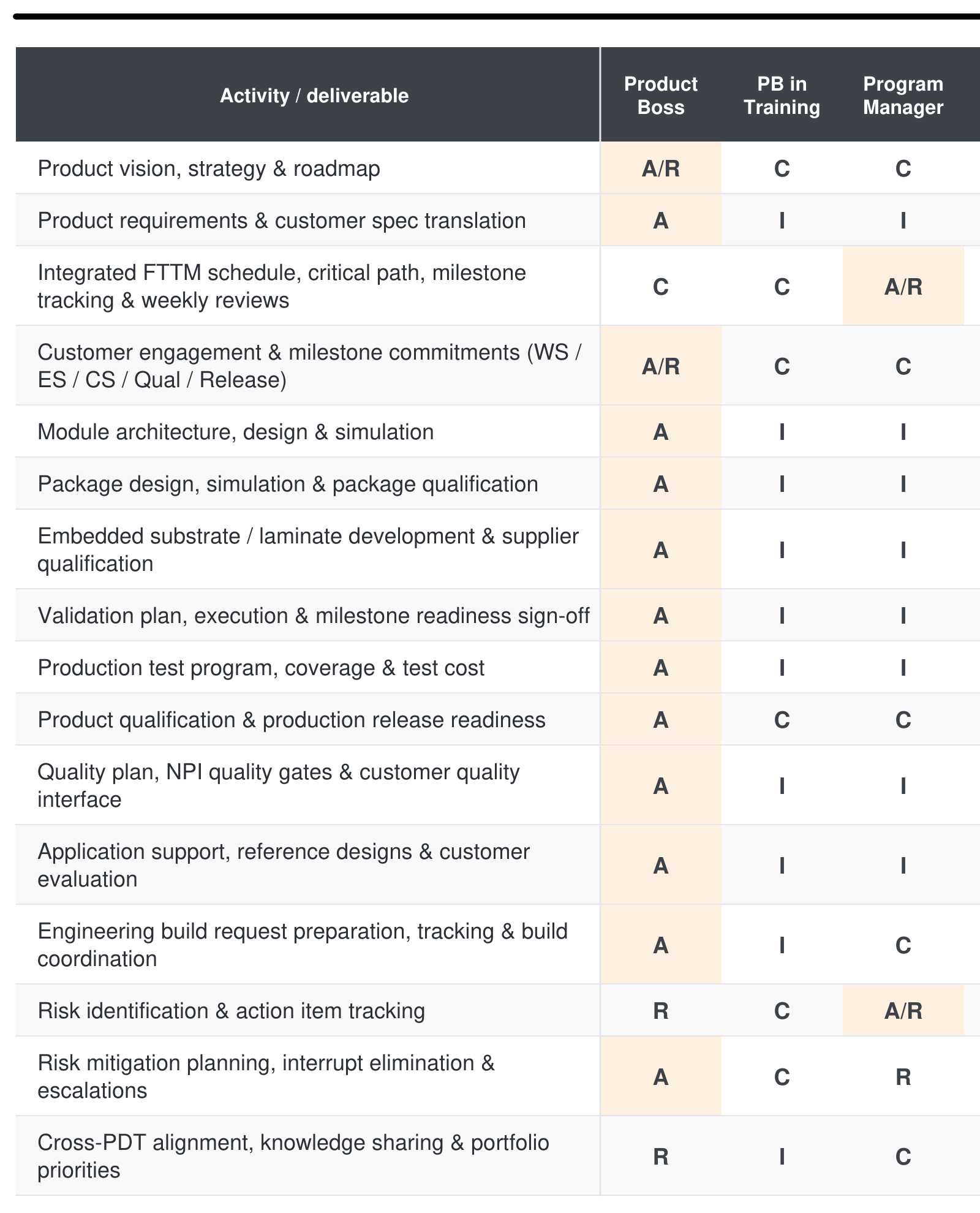
The split, dimension by dimension
- Focus. Product Boss: the what and the why — product outcome, customer, P&L. Program Manager: the how and the when — schedule, dependencies, execution.
- Horizon. Product Boss: the market window, concept to volume ramp. Program Manager: the next six weeks, in tasks of ten days or less.
- Primary instrument. Product Boss: cost of delay. Program Manager: critical path.
- Characteristic acts. Product Boss: provision the team, clear obstacles, hold the vision, decide the trade-offs. Program Manager: refresh the schedule, model pull-in, eliminate interrupts, drive the weekly drumbeat.
- Relationship to the team. Product Boss leads it, directs the Embedded Leads, reviews performance. Program Manager facilitates it; the team builds and owns the schedule together.
- Trade-offs. Product Boss makes the decision. Program Manager provides the impact analysis.
- Barriers. Product Boss removes organizational barriers. Program Manager removes execution barriers.
- Freedom scale. Product Boss: Level 1–2 on product decisions. Program Manager: Level 1 on schedule decisions.
The boundary cuts both ways
A Product Boss who micro-manages the schedule is doing COO work, which means nobody is doing CEO work. The vision goes unguarded, the team goes unprovisioned, and the obstacles stay standing.
A Program Manager who makes product trade-offs is doing CEO work without the accountability, the customer relationship, or the P&L behind it.
Both errors look like diligence from the outside. Both cost time.
Two failure modes
No CEO produces a well-run schedule pointed at the wrong product. Every milestone is green. The reviews are clean. The product arrives on a date nobody at the customer was waiting for, or with a specification that has drifted from what the customer will actually buy.
No COO produces a drifting schedule that reports status instead of driving work. The product vision is intact and articulate. The dates move a week at a time, and each move is individually reasonable.
Three questions that locate the gap
- What is the gap between the target schedule and the real schedule this week, in weeks? If nobody can answer with a number, there is no COO.
- Who made the last hard technical trade-off, and on what date? If the answer is a committee, a functional manager, or “we are still aligning,” there is no CEO.
- In the last product review, who presented the product and who ran the schedule tool? If one person did both, one of the two jobs is not being done.
Why both sides need Freedom Level 1
Each role operates at Freedom Level 1 inside its own domain: act, report after. That only works if each trusts the other’s domain rather than auditing it.
The Product Boss provides air cover for the Program Manager’s schedule authority, which is what gives the schedule teeth when a function pushes back. The Program Manager gives the Product Boss an honest gap every week, with no happy schedules, which is what gives the trade-off decisions their timing. Remove either half and the partnership collapses back into one person doing both jobs badly.
The scale is not local to this one boundary. Before the fact leadership treats Freedom Level 1 delegation as one of the three layers by which an organization learns to anticipate problems instead of reacting to them, and Four questions every product leader should ask works through what empowerment means once you make it precise.
The shortest version of the boundary: the Product Boss owns the product; the Program Manager owns the plan.
Downloads
The full role definition and its two companion documents: