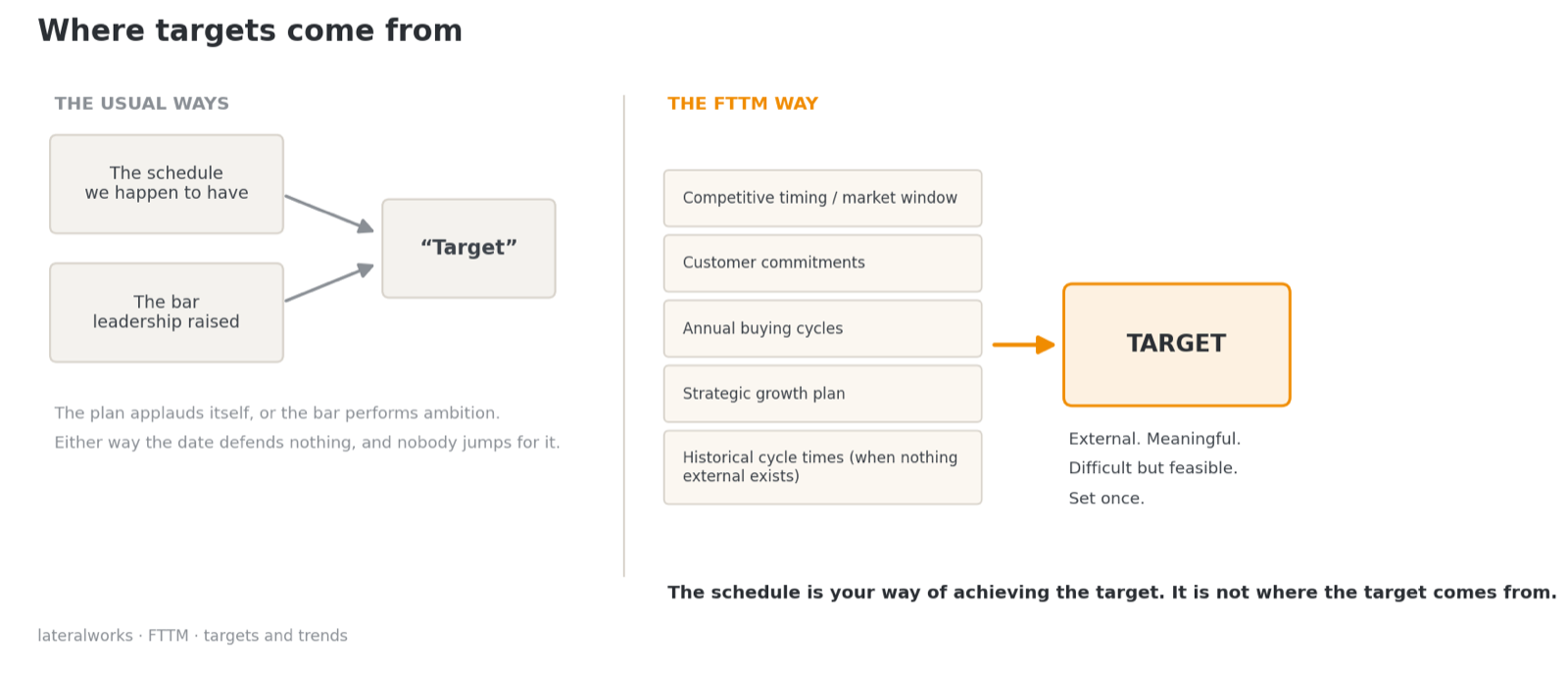
Ask a team where their milestone targets came from and the honest answer is usually the schedule. A program manager at a client asked us the question directly last week: should our target dates come from the pulled-in schedule, or from the baseline before the pull-in work? The answer is neither. A target that comes from your own schedule is not a target. It is the plan applauding itself.
The other answer is top-down. Leadership sets an “aggressive target” or raises the bar, on the theory that the higher the bar, the higher people jump. That is not how people work. When a target is impossible, teams stop jumping: they quietly give up on the date and keep the effort respectable. A target has to be difficult but feasible, or nobody tries to reach it. And it has to be based on facts, not top-down games.
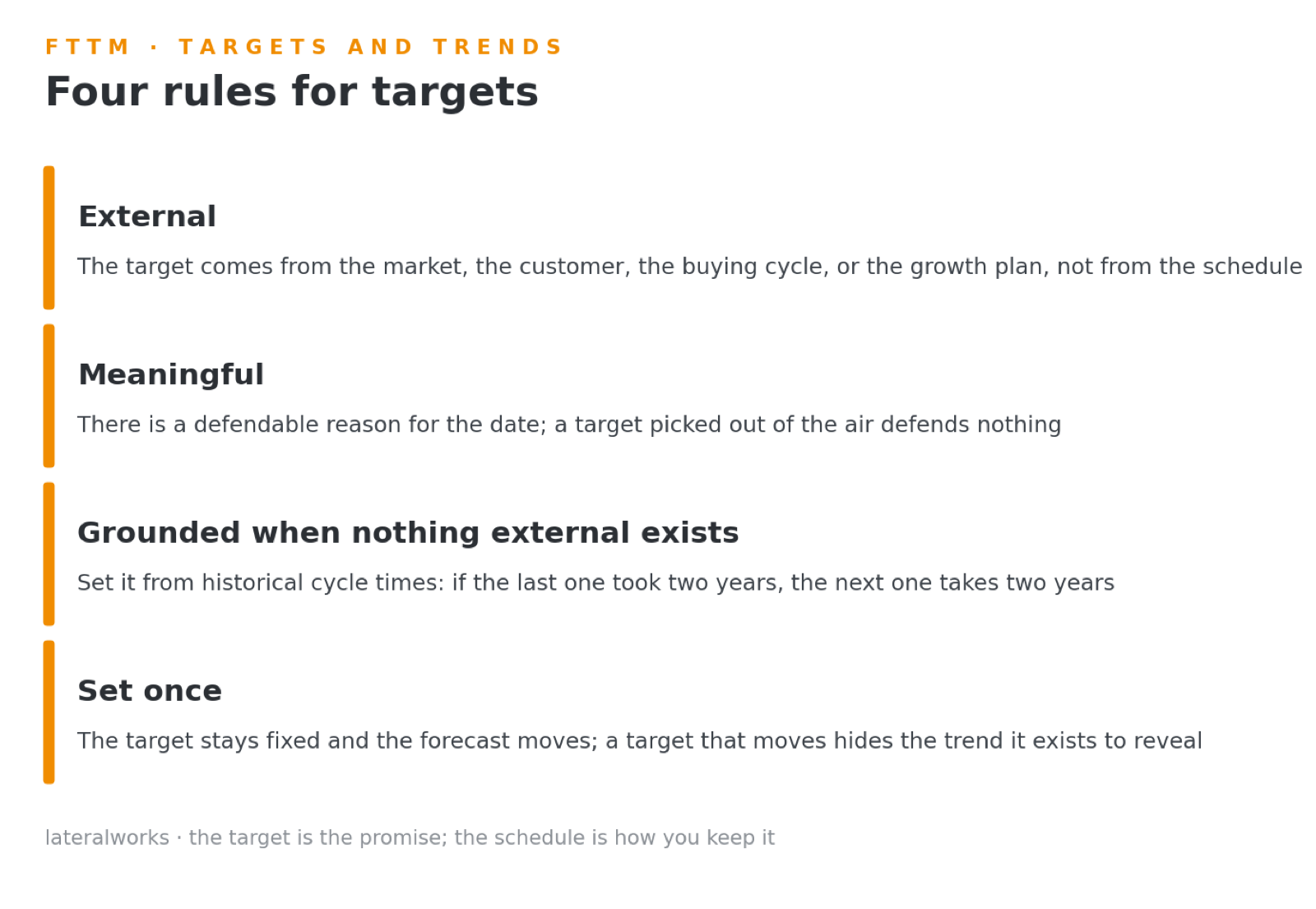
Targets come from outside the team. Competitive timing and the market window. A customer commitment. Annual buying cycles. The strategic growth plan, which is internally written but still external to the team. Your schedule is almost not important here. The schedule is your way of achieving the target.
Three kinds of targets
Targets take three forms. A fixed target date: one date, one promise. The Series C close, the customer’s line-down date, the trade show. A target window: a span of time the release must land inside, common when the driver is a buying season or an annual cycle rather than a single day. And a stretch-and-commit pair: an early stretch target the team plans and pulls in against, with a later committed date the company promises outward. The pair is the honest way to be aggressive. The team runs at the stretch date, the business stands behind the committed one, and the space between them is margin, held in the open instead of hidden inside the task estimates. On the wigglechart, the committed date is the fixed line; the trend is read against the commitment.
When nothing external exists
Some programs have no market window and no customer pounding the table. A refresh release nobody outside is driving still needs a target, and it comes from historical cycle times: if it took two years to get the last one out, it will likely take two years to get the next one out. That is where the target comes from. It is not that complicated. What you may not do is skip the target because the outside world is quiet. A program with no target has no gap and no trend, so it has no way of knowing whether it is winning.
A target must be meaningful
The point of a target is that it must be meaningful. There needs to be a defendable reason for the date. It is not picked out of the air. Targets trigger revenue estimates, and those estimates rest on the rate of growth the owners and investors are expecting. A date with nothing behind it defends nothing, and everyone on the team can smell it.
Here is what meaningful looks like. We are working with a client on a portfolio of cost-reduction projects. The target savings come from their Series C round, which has to close in eighteen months; that is the promise they made in their Series B. So the projects have to finish before then. That created the target date. If they hit their gross-margin and net-margin improvements, they are positioned to raise a billion-dollar round. The date is tied to something real, and the whole company can see the tie.
The before matters as much as the after. Before this work there were no targets and no schedules on the reduction projects; nobody knew whether the costs would come down in time for the round. The moment the targets were tied to something external, the schedules meant something. That portfolio now runs more than 25 projects and over 500 tasks.
Set once
A target is a contract between the team and the company. The team signs up for the date; the company signs up for the staffing, the decisions, and the priorities the date requires. That is why, once set, targets should not be changed: nobody renegotiates a contract because the work got hard. Everything a target is for depends on it standing still. Move the target and the gap becomes fiction and the trend loses its memory. Worse, the organization learns that dates are negotiable, the most expensive lesson a program can teach itself. Setting the target is therefore the moment to argue: pressure-test the reason for the date before it is locked, because that is the last cheap chance to change it. Re-baselining exists, at a gate, with the committee’s approval, and with the original commitment kept visible. It is a rare, expensive, public act. That is by design.
What targets are for: the trend
A fixed target is not ceremony. It is the reference line that makes trends readable. Every week the team refreshes the plan and re-plots the forecast finish against the target; the line the forecasts trace is the wigglechart. The gap between the line and the target is the exposure, in days. The slope is the direction of travel. This is the targets-and-trends discipline: the target stays fixed, the forecast tells the truth, and the trend between them is the management information.
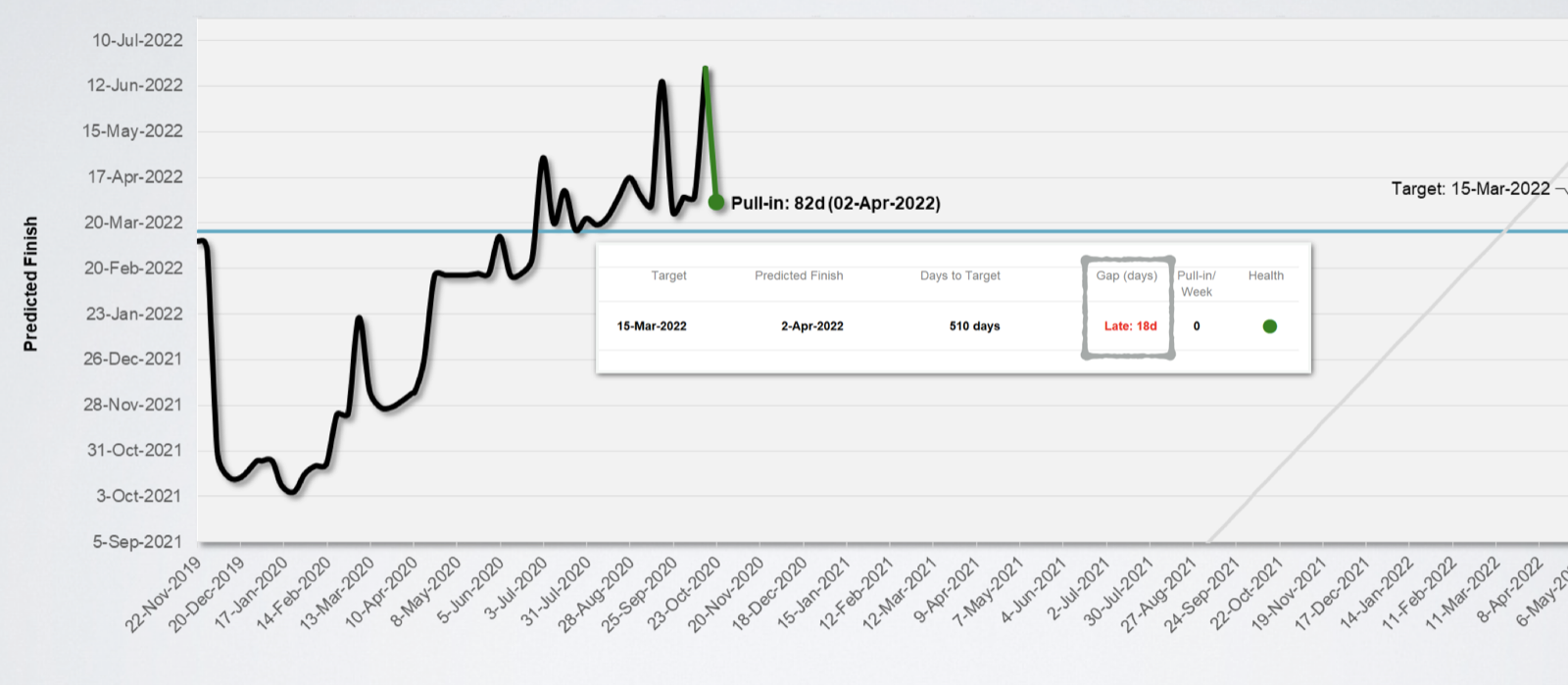
Read the chart the way an executive should. The refresh shown is 510 days before the target. The forecast had drifted to almost three months late, every wiggle a re-forecast in public. Then an 82-day pull-in in a single refresh brought the gap to 18 days. The program knows, seventeen months before the date, exactly where it stands and what recovered the last 82 days. That is what a fixed target buys. No status meeting produces that sentence.
The same instrument rolls up. In Portfolio schedule trends for the C-suite we showed a weekly deck generated from these charts across a whole portfolio. Every standardized milestone, every program, one page each:
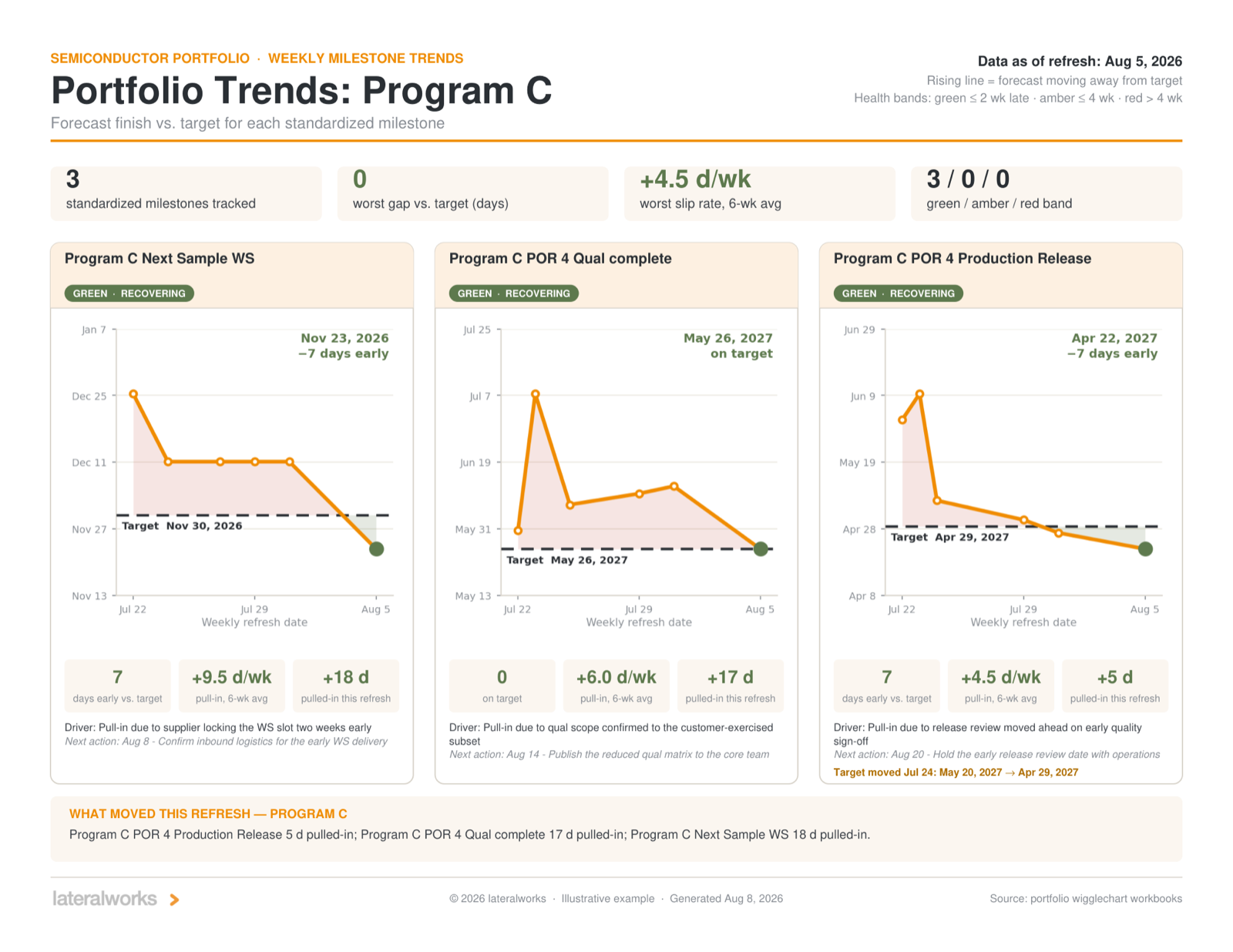
The two dates in every program tell you different things. The forecast tells you where the program is going. The target tells you where the business needs it to be. Keep them separate, one honest and one fixed, and the distance between them becomes the most useful number the program produces. The target is the promise; the schedule is how you keep it.
Related reading: When the customer slips (the companion post: what to do when the customer moves), Targets and Trends, Schedule Gap, Positive vs Negative Buffer (i.e. Margin), The Weekly Schedule Refresh, Building schedules using the practices of fast teams, My Schedule Keeps Slipping, Portfolio schedule trends for the C-suite, Ten numbers on two clocks, and Targets are top-down; schedules are bottom-up.