Analysis starts with questions ended with a short list: two mechanical design tasks, one on the critical path and one right behind it, both slipping, and both owned by a development partner an ocean away. The analysis finds the problem; the breakdown manages it. This article is about the breakdown, and specifically the hard version of it: decomposing near-term critical path work into tasks of five days or less when the people doing the work are an ODM in China, do not report to you, and do not plan the way you do.
It reads like a case study because it is one. The client is building a connected product, a systems program spanning hardware, firmware, software and cloud-based services, with the ODM carrying a large share of the development. The relationship began the way most client-ODM relationships in Asia begin: committed dates, polite updates, and very little insight into what was actually happening between them.
After the fact
The trouble with the default arrangement is structural, not personal. The ODM's work sat in the schedule as large, sealed tasks, and a sealed 21-day task has only two possible statuses: on track, and too late. Updates crossed the ocean as reassurance rather than visibility, and the first hard information arrived when a date moved. You only find out after the fact, and a team that only finds out after the fact is permanently in recovery mode, responding to slips it never saw coming instead of preventing them.
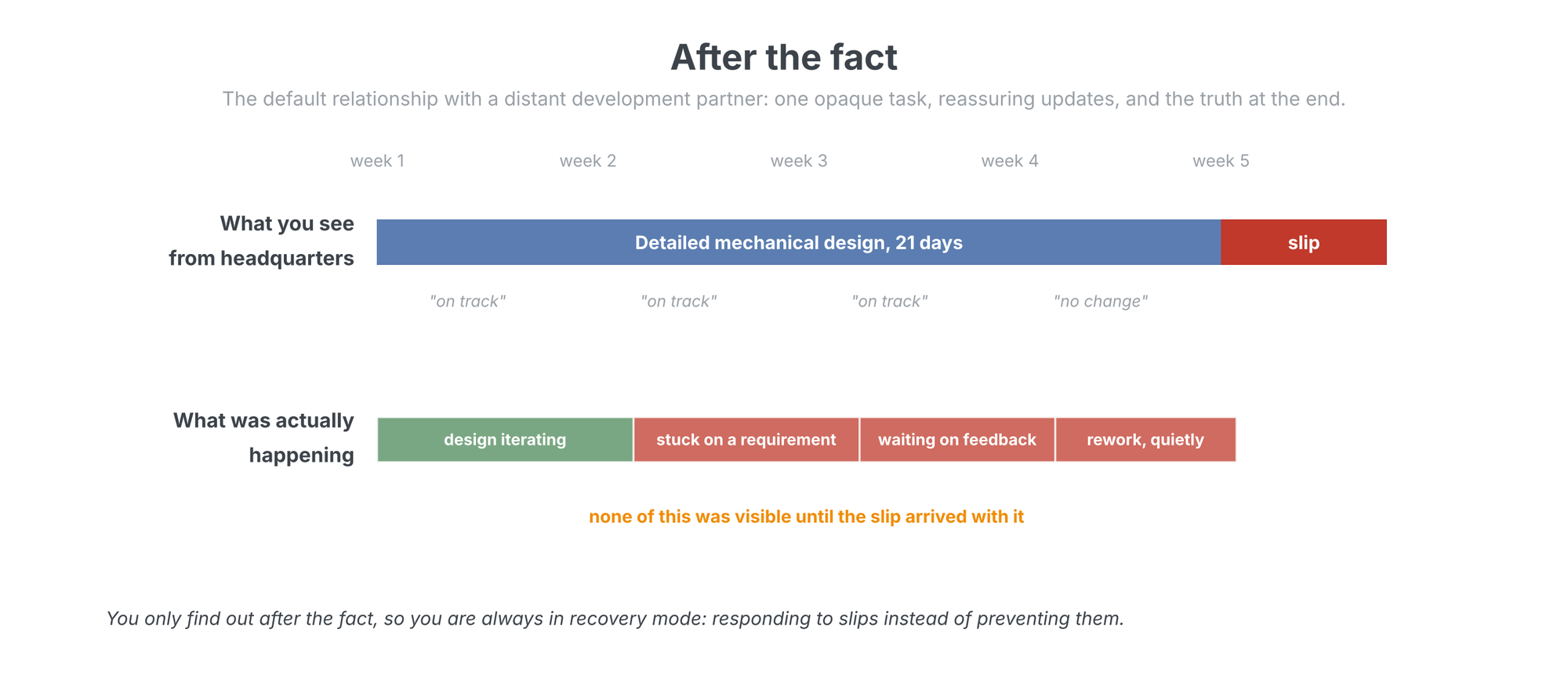
This is the normal condition of working with a CM or ODM, and most companies accept it as the cost of outsourcing. It is not. It is the cost of how the work is planned.
The first attempt
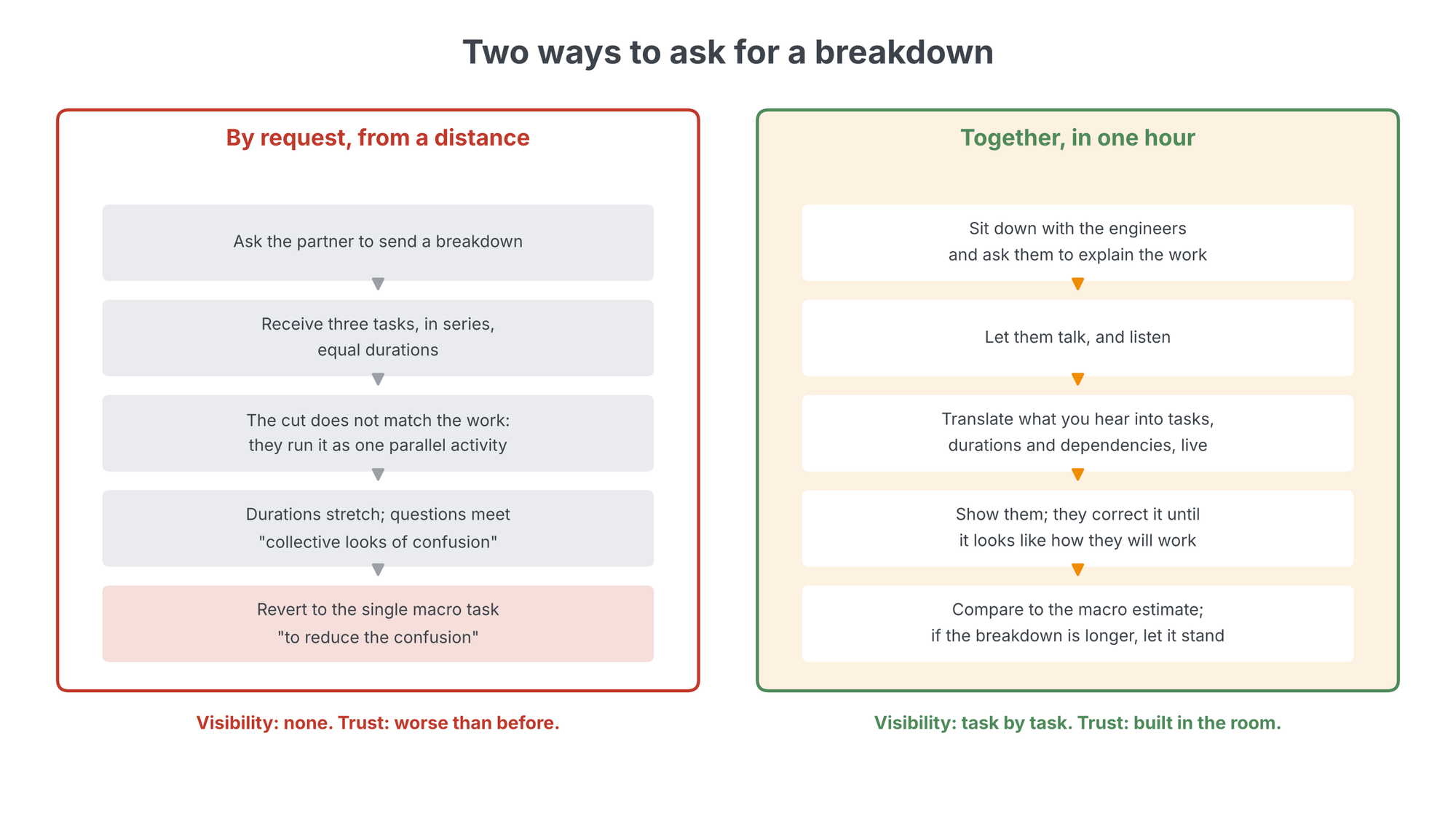
The client's program manager did the textbook thing. He asked the ODM for a breakdown of the mechanical design work, and he got one: three tasks, in series, with tidy equal durations. After the scheduling workshop he watched those tasks quietly stretch. When he asked the ODM's engineers why the tasks kept taking longer, he got what he described as collective looks of confusion, and then the real answer: the breakdown did not make sense to them, because all three tasks run at once. In their world there is no delineation at all; it is one activity called detailed design. So he reverted the schedule to the single macro task, to reduce the confusion, and the program was back where it started: one sealed box on the critical path.
His goals were exactly right. He wanted better breakdowns and more transparency, he wanted visibility into the ODM's work without bearing down on them, and he was alert to the failure mode where a partner complies on paper while quietly disengaging. The method is what failed, and it fails the same way for everyone who tries it. A breakdown requested over email produces a document, not a plan: the partner pattern-matches to what the template seems to want, three boxes in a row, and sends it back. The cut does not match the work, so the schedule and reality diverge from day one, and every status question lands on a structure the people doing the work never recognized. The confusion was not a language problem and it was not evasion. Most people, a solid majority, do not naturally think of their work as tasks with durations and dependencies. Ask them to produce your artifact and you get confusion. But ask them to describe their work, and they can do it perfectly, in any language.
Do it together
The advice we gave is the process we have run for thirty years, on hundreds of programs, on every continent where products get built. Schedule one hour with the engineers who will do the work. Take one near-term critical path task into the room. Ask them to explain the work, and then do the hardest part of facilitation: let them talk, and listen. Do not correct, do not rush, do not fill silences. The gaps and hesitations you hear are the risk register writing itself.
While they talk, translate. Convert what you hear into tasks, durations and dependencies, building the plan live in front of them rather than taking notes to process later. Then show them. Something changes when people see their own words organized as a network of tasks: they understand it immediately, and they start correcting it. Move this here, these two run together, that one needs the fixture first. Let them edit until the plan looks like how they will actually work. That back-and-forth is the whole method, and it only happens when you build it together. It works especially well when English is not everyone's first language, because the network of tasks is a language of its own, and everyone reads it.
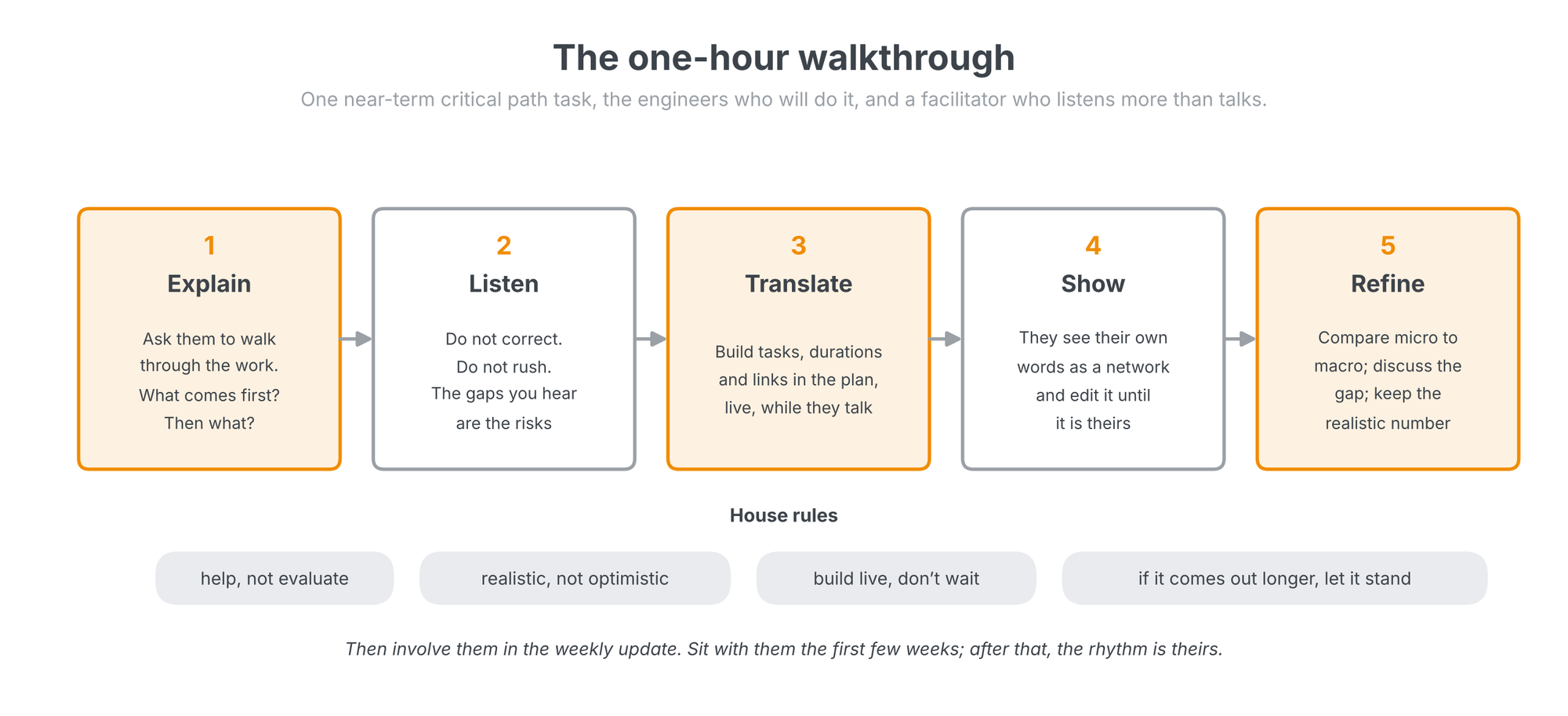
Two rules protect the result. First, when the micro breakdown disagrees with the original macro estimate, discuss the gap, and trust the breakdown; the micro view is usually the more accurate one. Second, if the breakdown comes out longer than the estimate, do not push it back down. Let it stand. You asked for the truth, and the first time you negotiate the truth away is the last time you get it. You are after realistic durations, not optimistic ones. And if a task resists cutting by its content, cut it by its flow: design, review, integrate feedback.
It is not micromanaging
Expect the partner, and your own team, to hear "breakdown" as "surveillance," and defuse it in plain words: we do not want to micromanage you. We need the detail so we have early warning, and so we can help you early, before a problem becomes a slip. Then behave that way, because teams detect within weeks whether the detail is being used to help them or to grade them, and the moment it becomes a scorecard the information dries up.
The key is to do it together
Planning together is the start of the communication, not the end of it. Use the plan to help them, not to evaluate them; they will see the difference fast. And when they plan the work with you, the plan becomes a commitment. A date assigned to a team is a demand. A date a team built is a promise, and in our experience with development partners across Asia, that promise is kept with real seriousness.
Then put the partner inside the rhythm instead of reporting into it. Give them access to the weekly refresh and have them update their own tasks. Sit with them the first few weeks; they pick it up quickly, and each small milestone they hit is accountability running in the right direction, from their own commitments rather than from your chasing. This is the same principle that makes an integrated core team work: the people doing the work own the plan for the work.
Break down only what is near
The objection to all this is effort, and the answer is scope. You do not break down the whole schedule; you break down the near-term critical path and the paths right behind it, and you leave everything else macro. Work inside the next month, on CP1 and CP2, belongs in 1-to-5-day pieces. Work three months out stays in 30, 60 and 90-day blocks until the weekly refresh walks it into the breakdown window. The detail follows the critical path through the schedule like a headlight, always a few weeks ahead of the work.
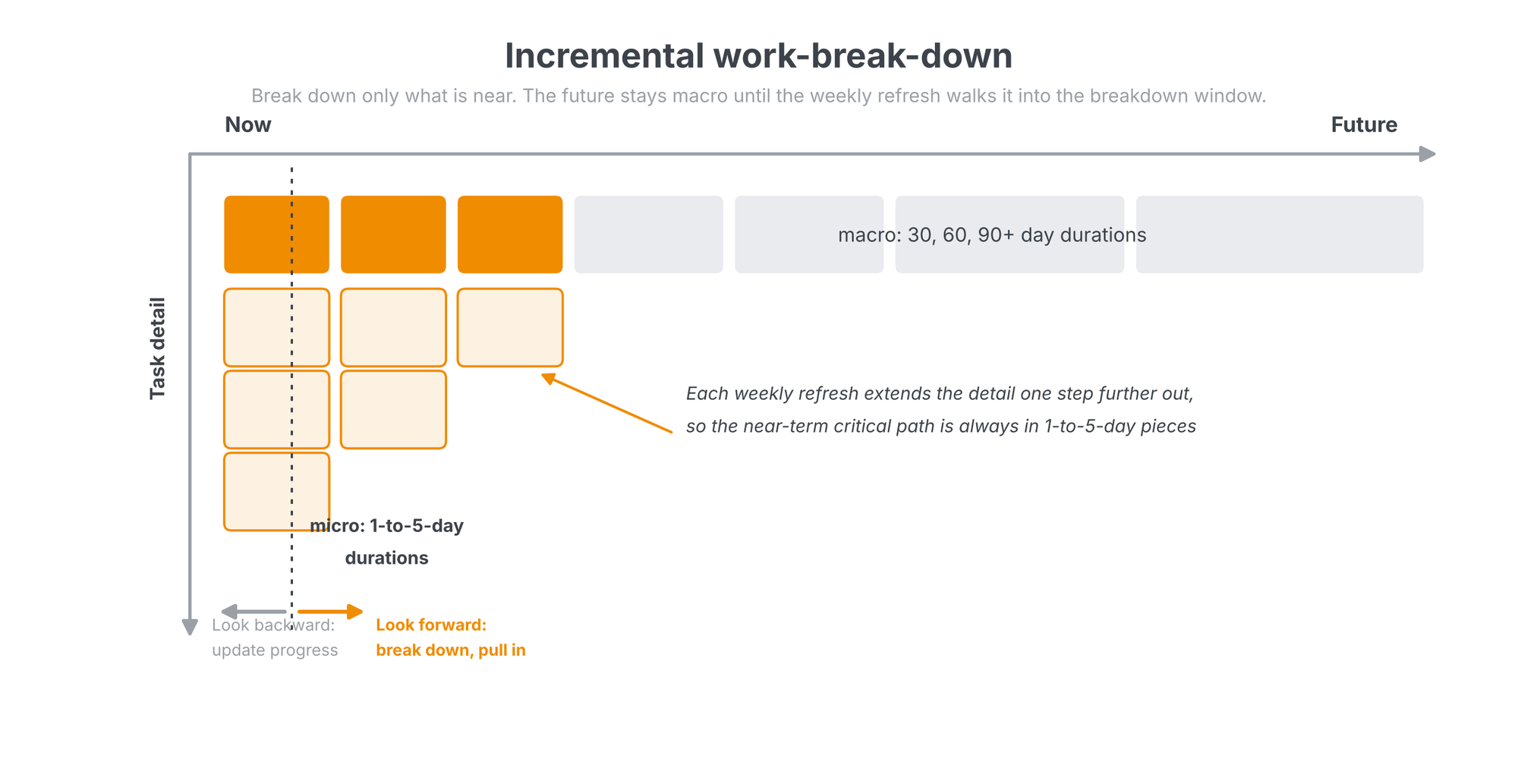
This is why the effort argument does not survive arithmetic. An hour per task cluster, plus a few weeks of shepherding the update habit, against a program that stops discovering its slips a month after they happen. The teams that skip the breakdown are not saving time; they are financing surprise.
One team, one schedule
Here is how it went. The walkthrough surfaced the real shape of the design work in the first hour, the parallel flow the emailed breakdown had missed, plus risks nobody had written down anywhere. The tasks that came out of the room were the ODM's own, in their own cut, sized in days not weeks. The ODM engaged, because the plan finally described their work instead of contradicting it, and because planning it together made it theirs. Slips did not stop; slips never stop. But they started surfacing in week one as task-level conversations, while there was still time to act, instead of arriving at month-end as finished facts.
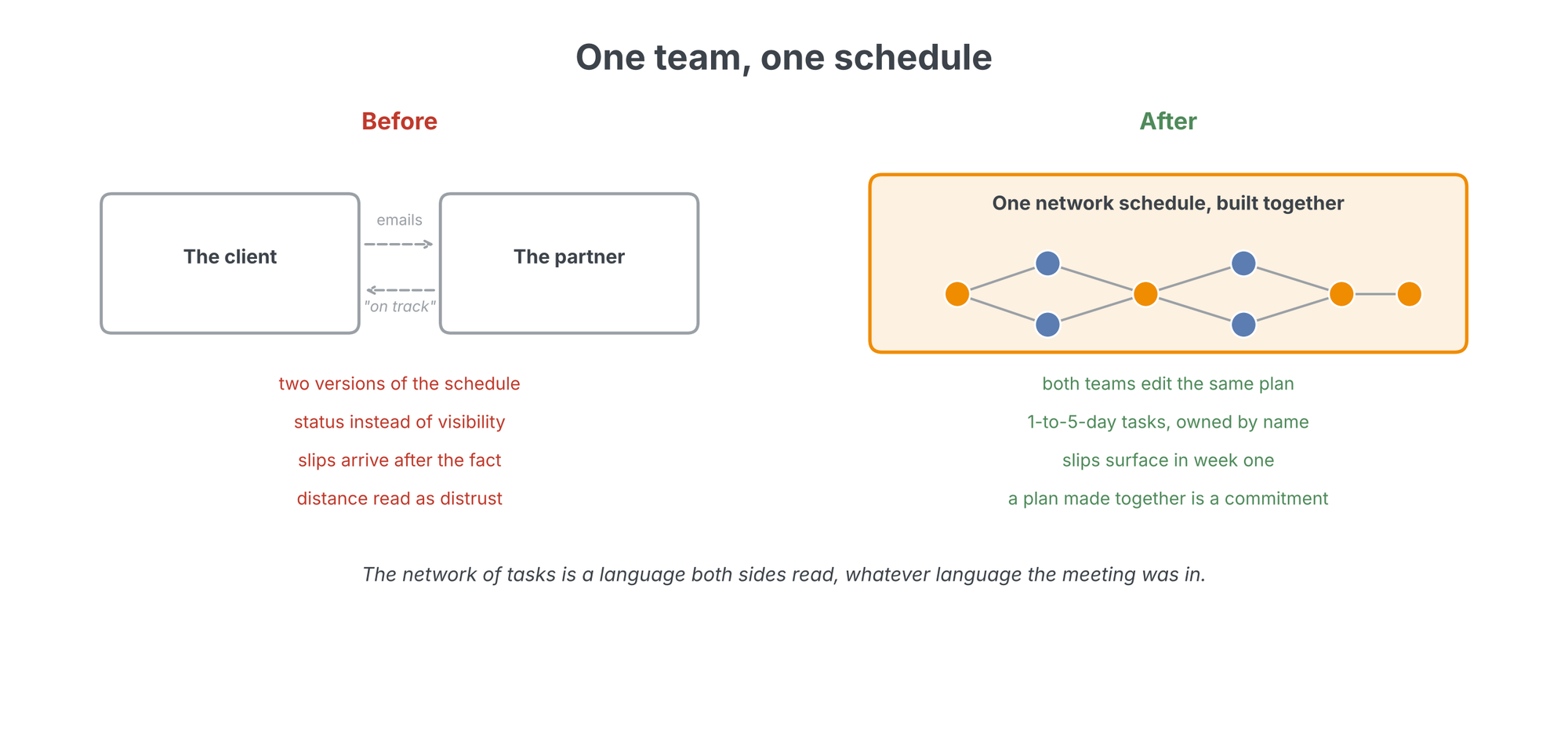
The dynamics changed with the plan: one team, one schedule, one set of shared outcomes, with the ocean and the language barrier exactly where they were before. We have watched this same process dissolve the "cultural" communication problems on programs all over the world, because most of what gets blamed on culture is actually structure: two companies holding two different pictures of the same work. Give them one picture they built together and the culture problem mostly disappears. That is also the quiet answer to one ODM, two schedules: the fix is not reconciling the copies, it is building one original, together.
From after-the-fact to before-the-fact
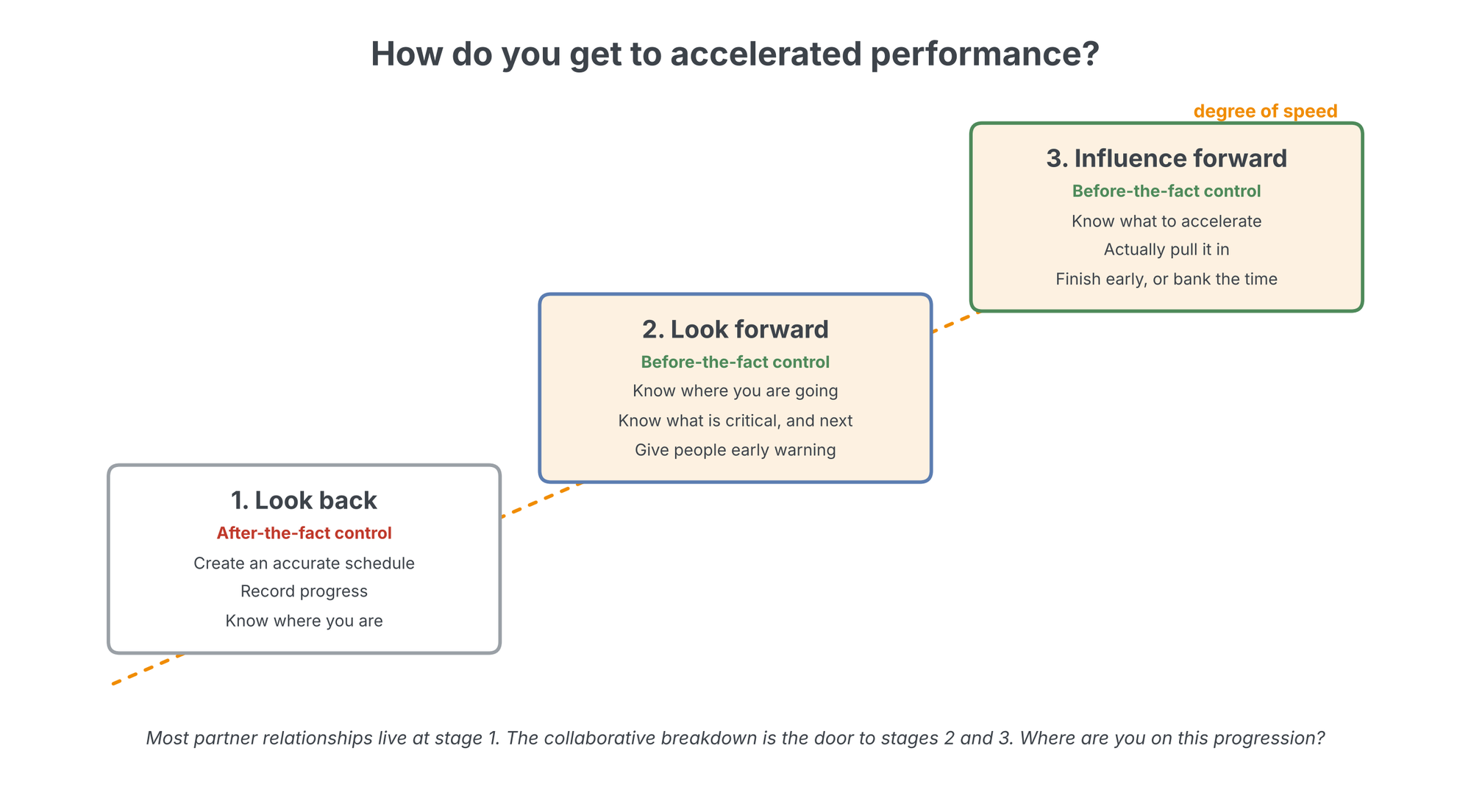
Step back and the breakdown is one move in a longer progression. After-the-fact control, an accurate schedule and honest progress, tells you where you are. Looking forward, which is what the near-term breakdown buys, tells you what is critical, what comes next, and gives everyone early warning. Influencing forward is the payoff: knowing what to accelerate, actually pulling it in, and finishing early or banking the time. Fast teams live at the third stage. Most partner relationships never leave the first, and the collaborative breakdown is the door between them.
One last thing about the craft. Done well, none of this is visible. The engineers will remember a good meeting where somebody finally asked them to explain their work; they will not remember being facilitated, and nobody will point at the moment trust got built, because it got built a task at a time, in the plan. That invisibility is why the skill is underrated, why it takes time to learn, and why it is worth it: it is the difference between managing a supplier and leading one team that happens to span an ocean.
Related on lateralworks: Analysis starts with questions and The weekly schedule refresh.