Every project runs on assumptions. Most of them are invisible. They were true once, or someone said them with confidence, and they hardened into the plan. Schedules are often held in place by beliefs nobody has examined lately, not by physics. The challenge process is a structured way to find those beliefs and test them, together, in a room.
The method extends Edward de Bono’s “challenge” technique: block the current way of doing things for a moment, not to prove it wrong but to ask whether it is the only way [1]. We have used it for years with engineering teams to pull in schedules and unstick programs. In one program the exercise produced a three-month pull-in, and the product reached the market within weeks of its target date [2].
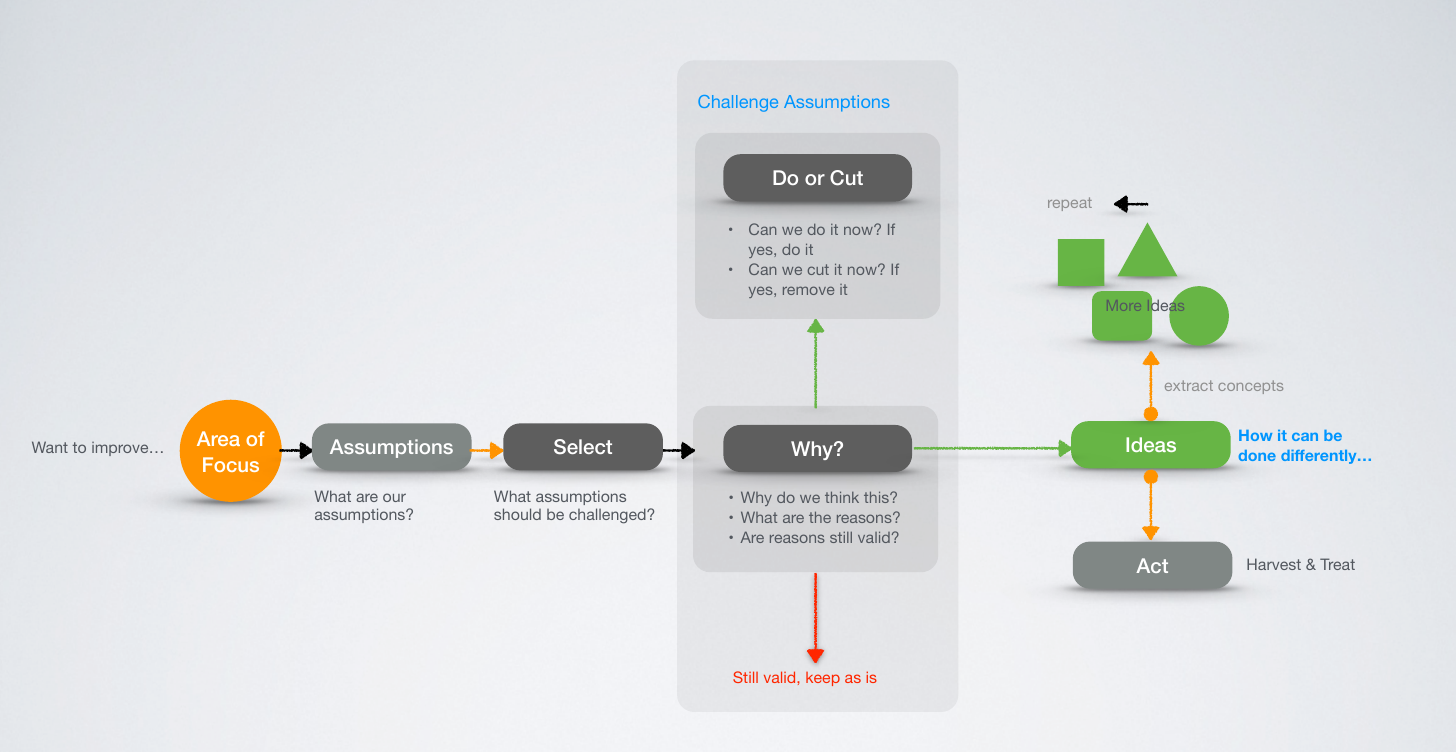
The steps
Start with an area of focus: the thing you want to improve. A slipping schedule, say, or a cost target that will not close.
Surface the assumptions. Every team member contributes two to four beliefs they hold about the program. A facilitator collects them anonymously and merges them into one list. Anonymity matters. The most useful assumptions are often the ones people hold privately and suspect the rest of the group does not share.
Select. You cannot challenge everything. Rank the list and pick the assumptions with the most leverage. The test for each one: if we relaxed it, would the schedule pull in? An assumption that changes nothing when relaxed has no leverage. Park it.
Ask why. For each selected assumption: why do we think this? What are the reasons? Are the reasons still valid? Some assumptions survive the questioning. Still valid, keep as is. That is a good outcome; the belief is now a decision instead of a habit.
Do or cut. Some challenges resolve on the spot. Can we do it now? Then do it. Can we cut it now? Then remove it.
Generate ideas. The assumptions that do not survive open the interesting question: how could it be done differently? Does this have to be done this way? Does it have to be done at all? Extract the concepts behind the first ideas, generate more, repeat.
Act. Harvest the ideas and turn them into actions with owners and dates. Without this step the workshop was a pleasant conversation.
Language is everything
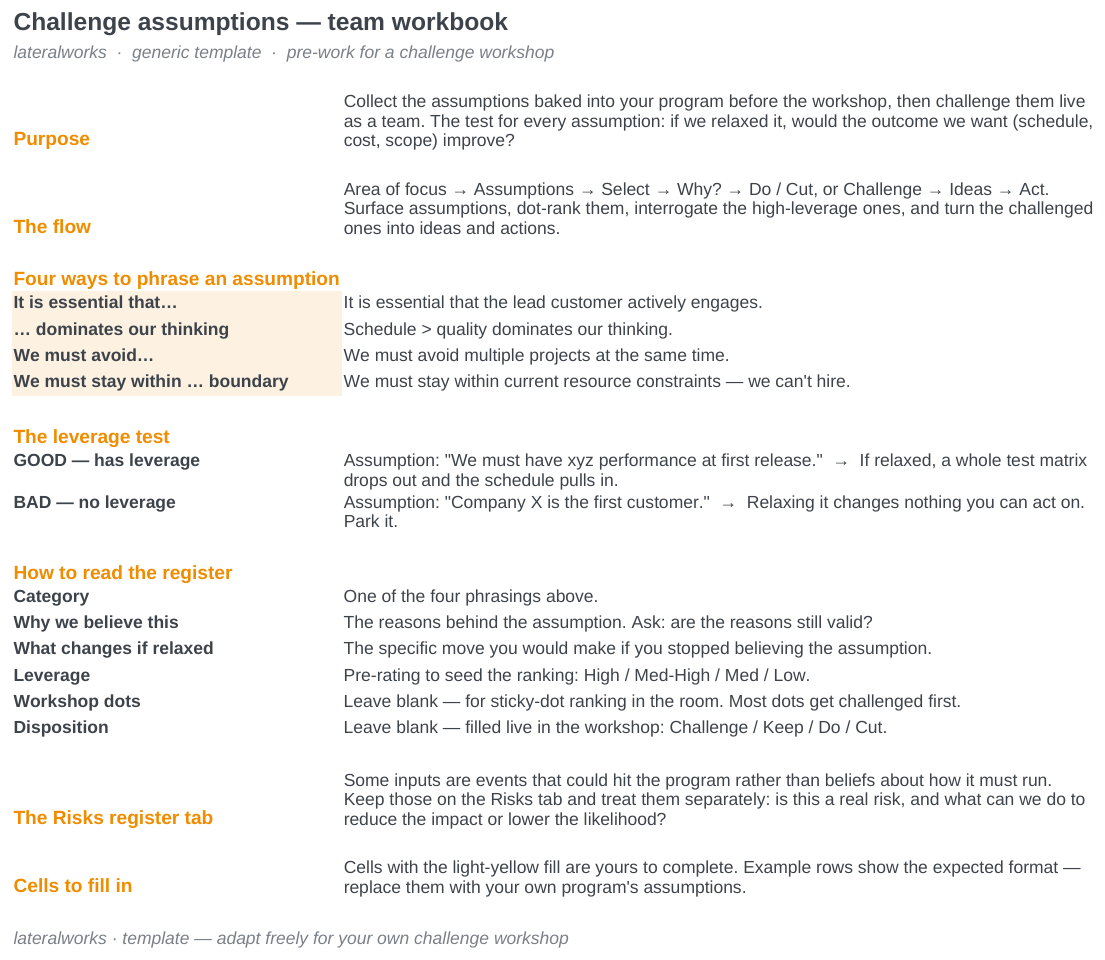
An assumption you cannot phrase crisply is an assumption you cannot challenge. We ask teams to start every statement one of four ways:
- It is essential that… — “It is essential that the lead customer actively engages.”
- … dominates our thinking — “Schedule over quality dominates our thinking.”
- We must avoid… — “We must avoid running multiple projects at the same time.”
- We must stay within … boundary — “We must stay within current resource constraints; we can’t hire.”
The four stems force the belief into the open. Essentials can be tested, dominant ideas can be named, avoidances can be questioned, and boundaries can be moved.
Before the workshop: the workbook
The live session works because of quiet preparation. In the weeks before, the submitted assumptions are merged into a challenge workbook: one row per assumption, with the category, why we believe it, what specific move we would make if we relaxed it, what part of the schedule that move attacks, and a pre-rated leverage level to seed the ranking. Two columns stay blank for the room: workshop dots and disposition.
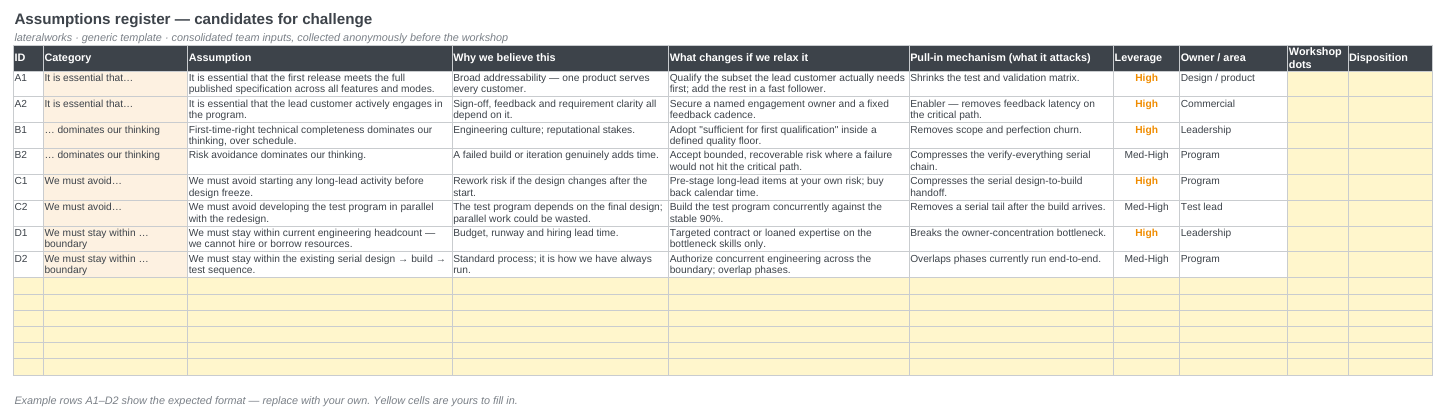
Some submissions turn out not to be assumptions at all. “The first silicon reveals a fundamental bug” is not a belief about how the program must run; it is an event that might hit it. Those move to a separate risks tab and get different questions: is this a real risk, and what can we do to reduce the impact or lower the likelihood? Applying the challenge questions to a risk does not work, and mixing the two muddies both conversations.
In the room
The lists go on the wall. The team dot-ranks them and works the entries with the most dots through the why questions. Each assumption leaves the room with a disposition: challenge, keep, do, or cut. There are no wrong entries; the point of the exercise is to surface disagreement. An assumption half the room holds as obvious and the other half has never heard of is exactly where the schedule is hiding.
The full registers from one program, anonymized — twenty-four assumptions and eight risks from a semiconductor qualification program — are in Appendices A and B of the article PDF below. A generic version of the challenge workbook is also available for download. Adapt the example rows to your own program and use it to collect your team’s assumptions before the workshop.
References
[1] de Bono, E. Serious Creativity: Using the Power of Lateral Thinking to Create New Ideas. HarperBusiness, 1992.
[2] lateralworks. “Breakthroughs by Challenging Assumptions.” lateralworks.com, January 2019.