Two clients, two very different businesses. One builds connected consumer products and is standing up an innovation system. The other is scaling a semiconductor module line toward a committed ramp. Both asked us the same question this year: of everything we could measure, what deserves a permanent place on the wall?
Both answers came out to twelve metrics on a single page.
The matching count is not an accident. Twelve is roughly the number a leadership team can review together in one sitting and still argue about. Past that, the review becomes a reading exercise and the numbers stop changing behavior. We made the full argument in our paper Twelve numbers, published in August. These two wallcharts are what that argument looks like when it lands in a real business.
Here is the innovation version, built for the consumer products client:
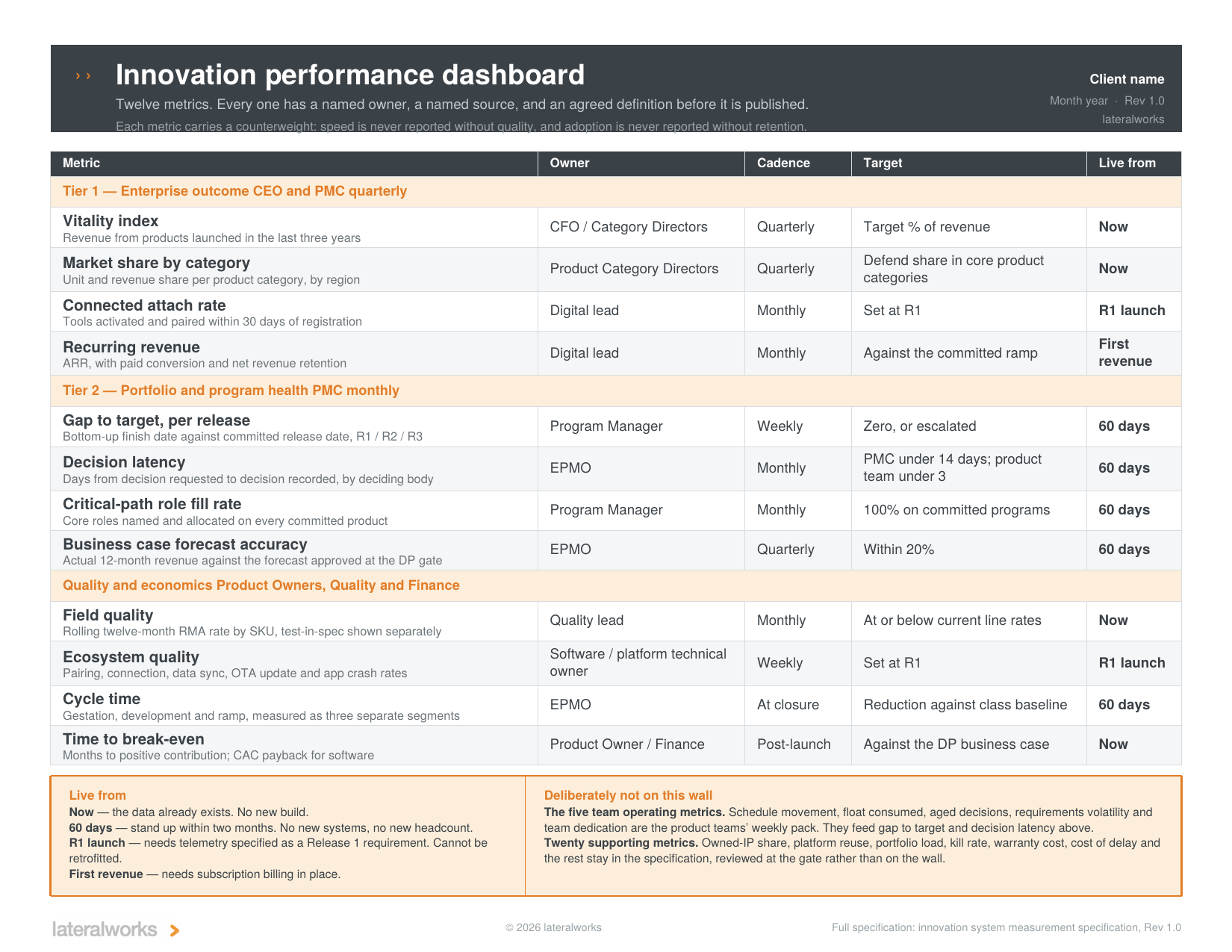
Click the chart to download the PDF wallchart.
And the program version, built for the semiconductor client:
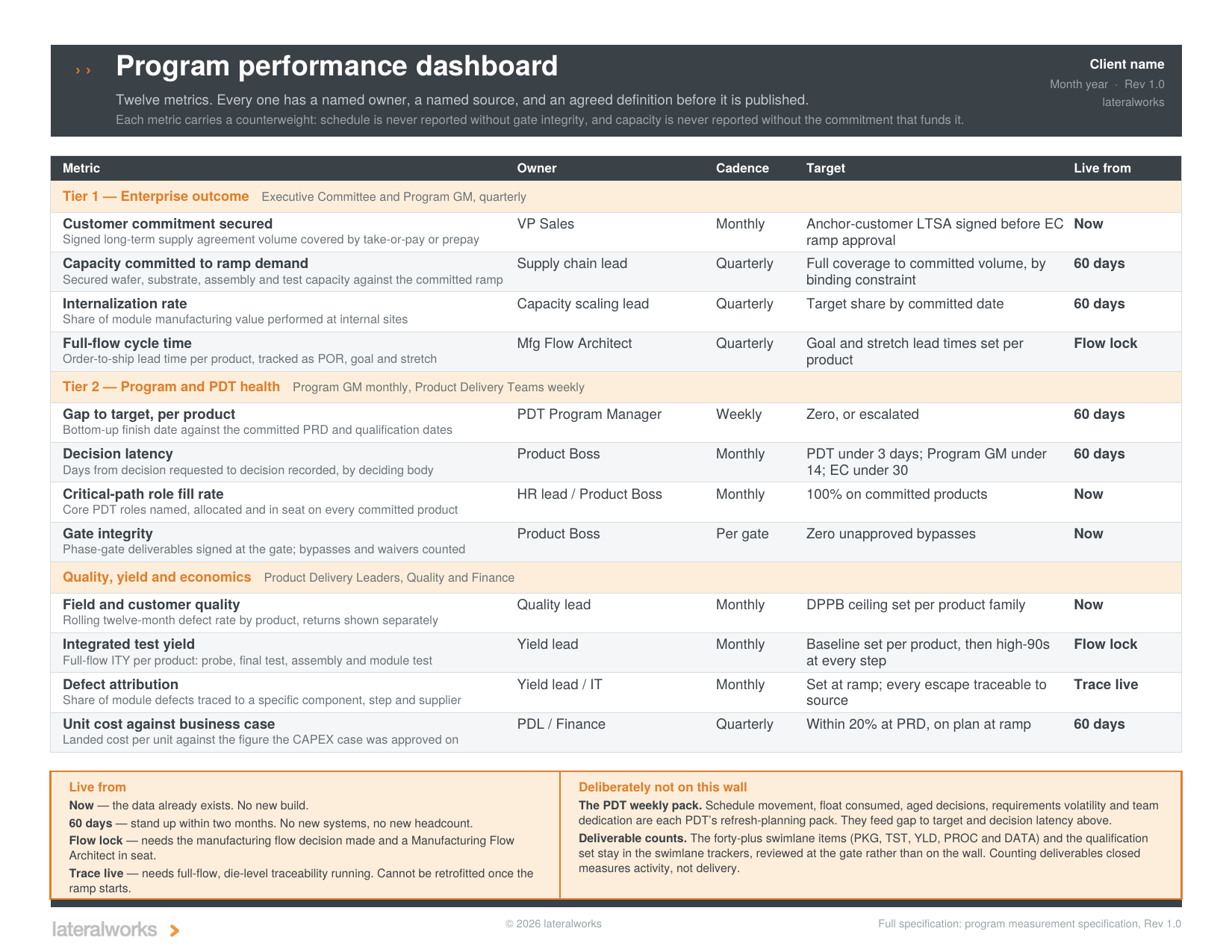
Click the chart to download the PDF wallchart.
The metrics differ because the businesses differ. What the two walls share is the set of rules that produced them. Four of those rules do most of the work.
Every metric has a named owner before it is published
Not a function. A person. On the innovation wall, the vitality index belongs to the CFO and the category directors; decision latency belongs to the EPMO. On the program wall, gate integrity belongs to the Product Boss and defect attribution belongs to the yield lead and IT. Owner, source, and definition are agreed before the number appears in public. A metric nobody owns is a metric nobody fixes.
Every metric carries a counterweight
Speed is never reported without quality. Adoption is never reported without retention. On the program wall, schedule is never reported without gate integrity, and capacity is never reported without the customer commitment that funds it. Unpaired metrics get gamed; paired metrics get managed. If a team can hit the number on the wall by quietly damaging something that is not on the wall, the wall is teaching the wrong lesson.
"Live from" is a date, not a wish
Each wall is honest about when each metric can actually exist. Some are live now, because the data already exists. Others stand up within 60 days with no new systems and no new headcount. The rest cannot exist until a specific decision is made: connected attach rate needs telemetry specified as a Release 1 requirement, and defect attribution needs die-level traceability running before the ramp starts. Neither can be retrofitted. Putting that constraint on the wall, in public, is how measurement requirements survive the descoping conversations that hit every program.
What is deliberately not on the wall matters as much as what is
Each team's weekly operating pack (schedule movement, float consumed, aged decisions, requirements volatility, team dedication) stays with the team and feeds the wall; it does not appear on it. The innovation wall keeps its twenty supporting metrics in the measurement specification; the program wall keeps its forty-plus swimlane deliverables in their trackers. Both get reviewed at the gate rather than on the wall. And deliverable counts stay off entirely, for a reason the program wallchart states plainly: counting deliverables closed measures activity, not delivery.
Strip away the industry-specific tier from each wall and the middle is nearly identical: gap to target, decision latency, critical-path role fill rate, and a hard quality number. A consumer products company and a semiconductor manufacturer, measuring program health with the same four instruments. Thirty-six years in, we keep finding that the things that kill programs are the same everywhere: dates that drift silently, decisions that sit, roles that stay unfilled, and quality debts that come due at the worst time. The wall exists so none of those can hide.
Both wallcharts are downloadable above in their generic form. If you want the row-by-row reasoning, and how a leadership team reviews the page as one conversation, that is Twelve numbers.