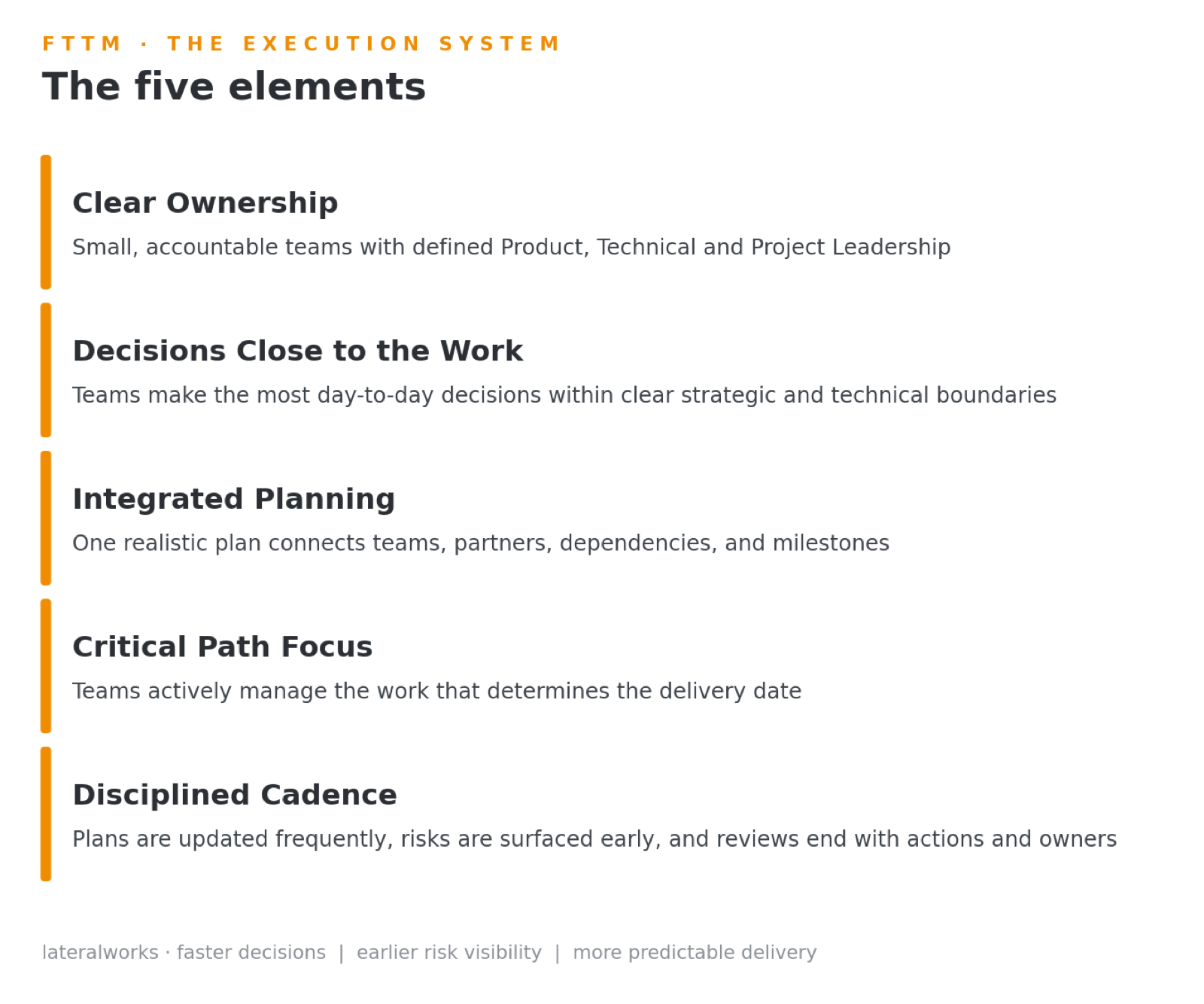
Most companies have a product development process. Very few have an execution system. The difference is easy to state and expensive to miss: a process tells you which documents to produce at which gate; an execution system determines whether the date holds. FTTM is an execution system. It comes from watching more than five hundred people on hundreds of technology programs since 1988, and it resolves to five elements: clear ownership, decisions close to the work, integrated planning, critical path focus, and a disciplined cadence.
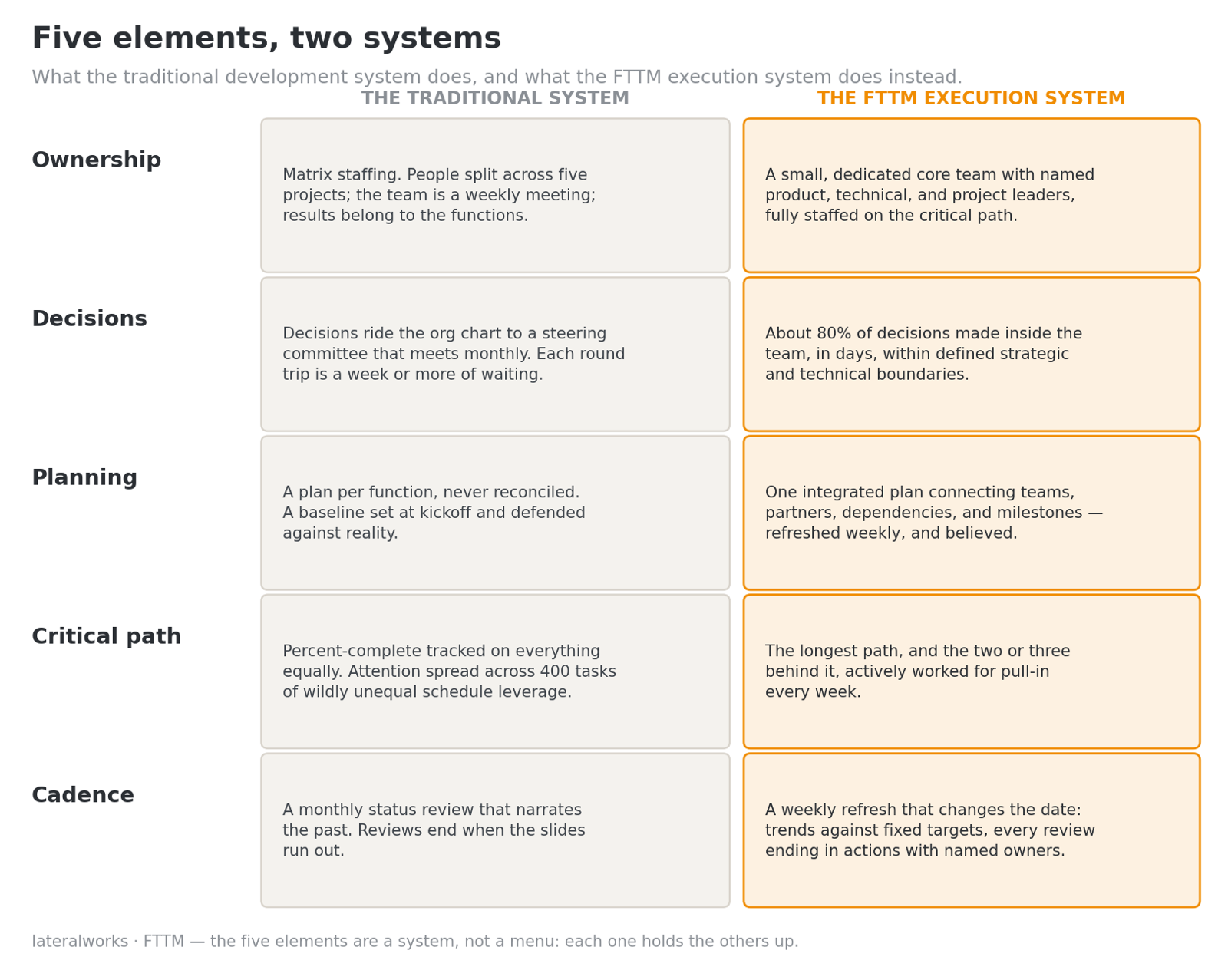
None of the five is exotic. What makes the system different from traditional new product development is what it optimizes. The traditional system inherited its shape from the org chart: work assigned to departments, people spread across projects to keep everyone utilized, decisions riding the hierarchy, plans baselined once and defended, reviews looking backward. Each choice is locally sensible. Together they optimize for the way the company is drawn rather than the way a product actually moves: horizontally, across every function, along one critical path. We made the measurement half of this argument in Ten numbers on two clocks; the five elements are the execution half.
Clear ownership. A small, dedicated core team with named product, technical, and project leadership, fully staffed on the critical path. The traditional system staffs a matrix instead: people fractionally allocated across five projects, identifying with the function that controls their raise, and the “team” reduced to a weekly meeting. The integrated core team is the strongest predictor we see of programs that ship on time, and the benchmarking literature agrees: in the APQC study, genuinely cross-functional teams with one leader were present in 79 percent of the best-performing businesses and 8 percent of the worst. The definition carries the teeth: staffed means named by the functional manager and released to the team. A name on an org chart with no released time counts as zero. Who owns the product, who owns the plan is settled on day one, in writing.
Decisions close to the work. With decision rights defined — a bounding box of strategic and technical boundaries — about 80 percent of day-to-day decisions belong inside the team and get made in days. The traditional system escalates: decisions ride the org chart to a steering committee that meets monthly, and each round trip costs a week or more of pure waiting. Nothing on a Gantt chart shows the queue. Slow decisions are the quietest way a fast program dies, and the return on fast decision-making is among the most reliable findings in our field research. Not every call belongs to the team — there are three types of decisions, and the bounding box says which is which — but the default is inside.
Integrated planning. One realistic plan that connects the teams, the partners, the dependencies, and the milestones, built from a macro plan down rather than assembled from functional fragments up. The traditional system runs a plan per function and reconciles them never: two planning views that disagree on scope, no rolled-up critical path, and a baseline defended against reality because honesty gets punished as slippage. You cannot manage a critical path that exists in no single plan. The FTTM planning concepts exist to make one plan the program actually believes.
Critical path focus. The team actively manages the work that determines the date — the longest path, and the two or three behind it, because the path that bites is usually the one you were not watching. The traditional system tracks percent-complete on everything equally, which spreads attention evenly across hundreds of tasks of wildly unequal schedule leverage; a program can be 94 percent complete and going nowhere. Watching the second or third critical path is what turns schedule management from bookkeeping into pull-in.
Disciplined cadence. Plans refreshed in the sixty-minute weekly refresh, forecasts told honestly against fixed targets, risks surfaced when they are small, and every review ending in actions with named owners. The traditional review is monthly and narrative: each function reports a number the others cannot act on, and the room disperses. The rhythm of accountability is what makes trend data mean something. Updating tells you where the program is going; pull-in actions and timely decisions change where it is going.
A system, not a menu
The five elements hold each other up, which is why sampling them fails. A dedicated team without decision rights waits in the same queues as everyone else. A weekly cadence with no integrated plan refreshes nothing worth reading. Critical path focus on a plan per function watches a path that does not exist. Decision rights without a team to hold them scatter into the matrix. Companies that adopt one element, stall, and conclude the methodology failed have run a fair test of the element and no test at all of the system.
That interlock is the honest answer to why FTTM is different. Traditional development systems are control systems: they exist so the organization can account for the program. The execution system exists so the team can move it. Faster decisions, earlier risk visibility, and more predictable delivery are not goals you can mandate from the front of a room. They are outputs of ownership, boundaries, one plan, the right focus, and a rhythm, running together. On a whiteboard it reduces to three words: people, planning, product, on one operating rhythm.
The one-page comparison is available below as a reference.
Related reading: Integrated Core Team, What is the R.O.I. of fast decision-making?, Three types of decisions, Start with a macro plan, The Critical Path You’re Not Watching, The Weekly Schedule Refresh, The Rhythm of Accountability, and Ten numbers on two clocks.