A client executive building escalation triggers into a gate process asked the question every program eventually asks: when do you change a target? It is the right question, because the answer decides whether the weekly trend means anything at all. The answer fits on one page, and the page is below.
A target is an external constraint
The target comes from the market window, a customer commitment, a buying season or the growth plan, never from the schedule. The team owns the schedule and the weekly forecast; the target is the contract between the team and the company, and nobody renegotiates a contract because the work got hard.
So a target moves for two reasons only: the external driver behind it moved, or the date has become a fiction nobody is jumping for. Either way, leadership makes the call once, at a gate, in the open, and the original commitment stays visible on the chart. On a healthy program the rarer event points the other way: when a target does change, it moves earlier, not later.
Everything else is a gap
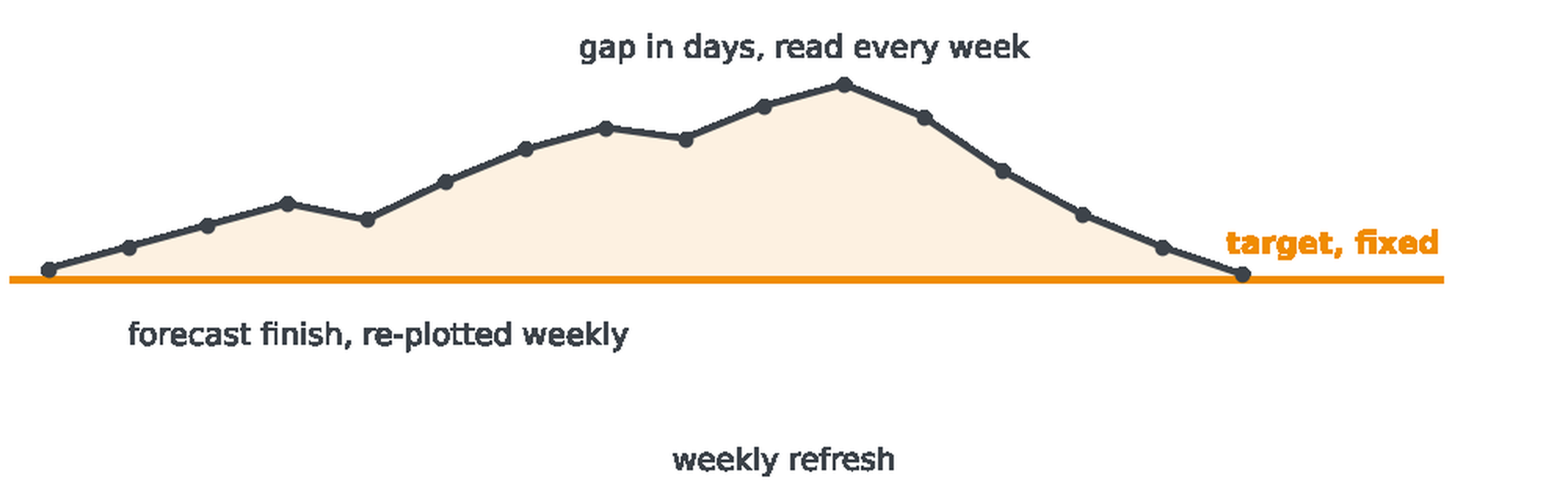
A fixed target is the reference line that makes the trend readable. Every week the team refreshes the plan and re-plots the forecast finish against it; the distance between them is the exposure in days, and the slope is the direction of travel. When the gap will not close, the team states it in days and proposes the pull-ins that would close it, with the risk priced. Then leadership decides.
The four moves
- Accept the risks and fund them.
- Change the definition.
- Retarget, once, in the open, at a gate.
- Kill the project.
Retarget is on the list. What is not on the list is drift: a target that slides out a week at a time until nobody remembers what the date was for. Drift is an early warning of a future failure, and it is corrosive in a way a hard slip is not, because the gap becomes fiction and the wigglechart loses its memory. A project that looks unrecoverable is still worked as a gap, in days, until leadership picks one of the four moves.
The bounding box fits the rule
Several clients run a bounding box, a practice that came out of Tektronix: a target plus limits, agreed at each phase gate. It fits the rule, read correctly. A limit is a review trigger, not a new target: cross one and the gate convenes. Before the definition gate the target is a window, so narrowing it at the concept and planning gates is the window closing, not a reset. The definition gate is where the window becomes a point and the contract is signed; reopening it afterward is a public act at a gate. Inside the box the team acts without asking, and a breach is a decision for leadership, taken once.
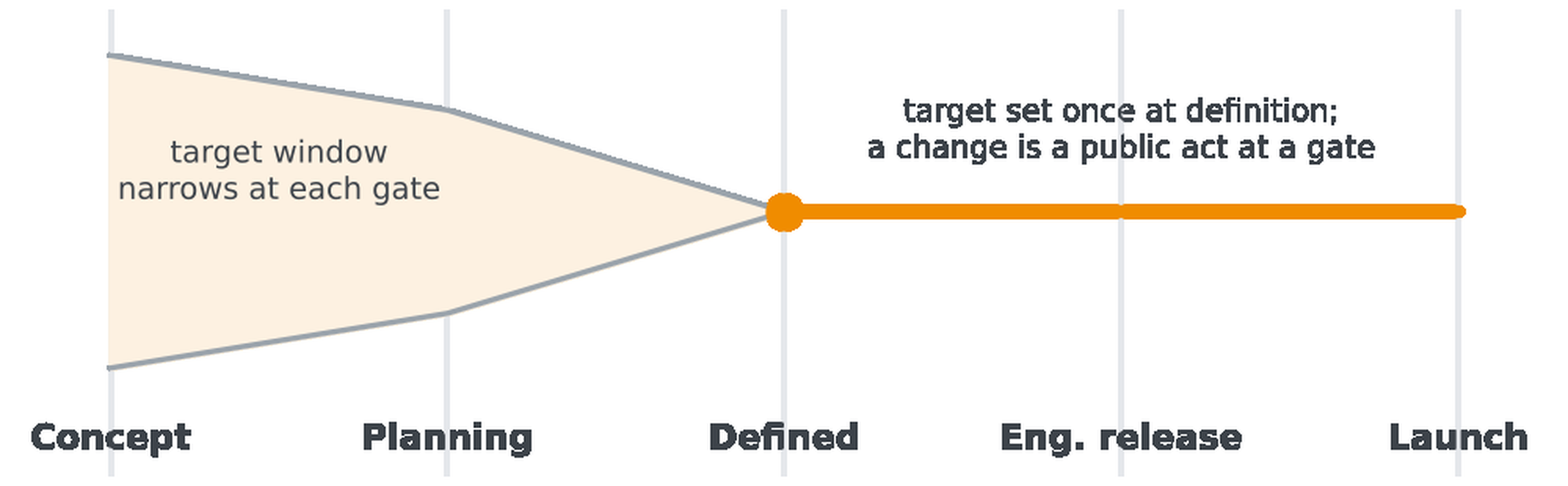
One caution from the field: keep the bounding box in the gate reviews and leave the production wigglechart alone. Limit lines on the chart would add complexity for the many people who already read it every week, and would suggest the one thing the chart exists to deny, that targets can be reset.
Case study: a target that moved only with the market
The rule is easiest to see on a real program. The Fab 8 build, a $7 billion fab constructed in under two years, moved the target for its First Silicon Starts milestone three times, always on an external driver: one slow-down, then two pull-ins. During planning, a global recession hit the tech industry, worldwide semiconductor sales fell 9 percent in 2009, and the demand forecast said slow the fab down. Once the project was under way conditions reversed sharply, 2010 closed as a record year with sales up 31.8 percent, the demand curve climbed, and the target moved forward, earlier. Then it moved earlier again, when the company's other fabs could not meet the accelerated demand and the load shifted to the new fab.
The economics behind those calls is the clearest external driver you will find: the day a tool is turned on, its depreciation charges start. A fab running at capacity absorbs depreciation without noticing; turn tools on ahead of demand and it is an expense the business plan cannot carry. So the target tracked demand and capital economics, never the schedule.
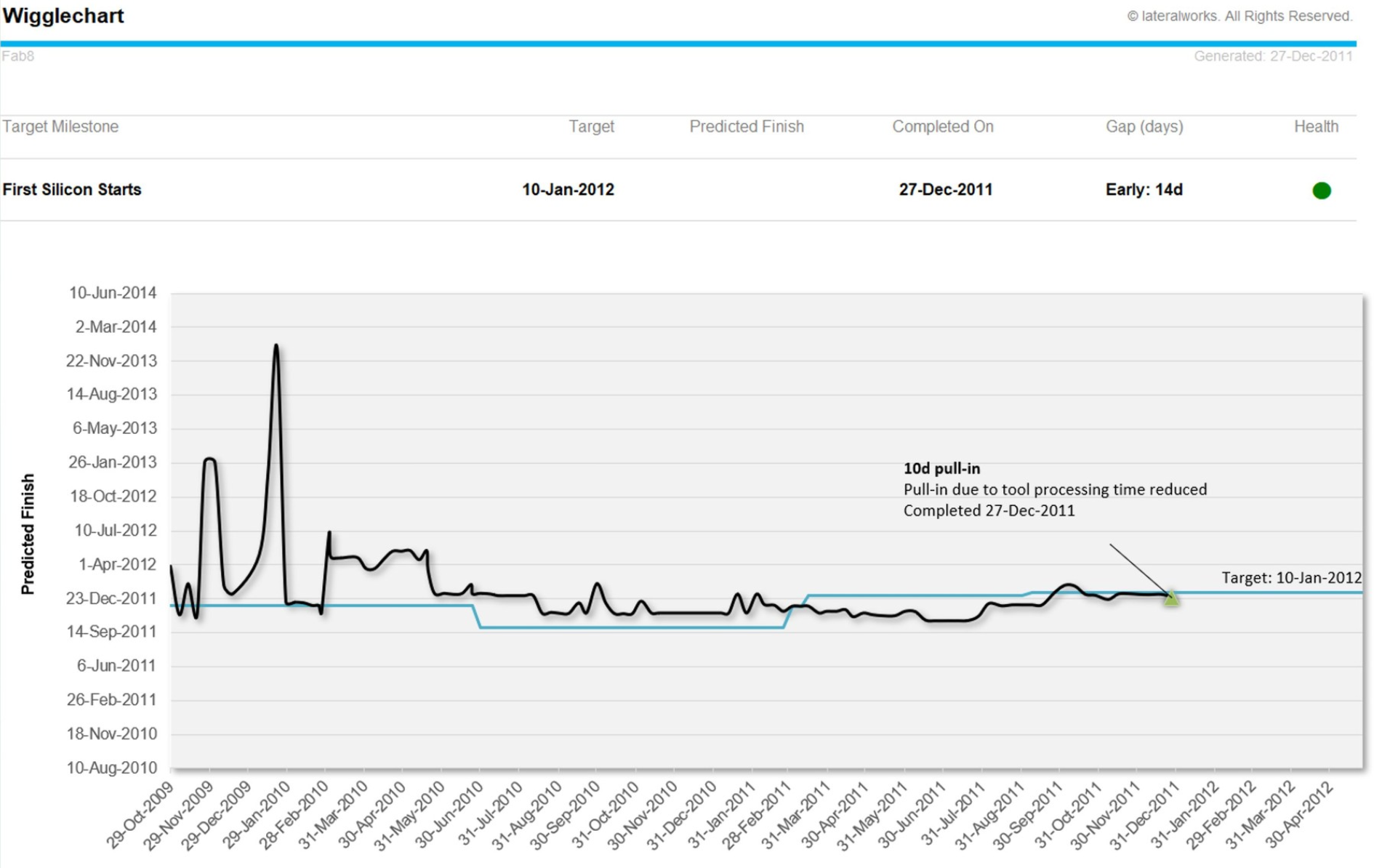
And look at what the schedule did: it tracked the target. When the target pulled in, the schedule accelerated; when the target relaxed, the schedule relaxed with it. Two years of weekly forecasts hug the target line through every move, and the milestone closed 14 days early, the last 10 bought by a specific pull-in, reduced tool processing time. That is the behavior a fixed, externally driven target buys: the team jumps for the date on the chart, whichever date leadership has set there.
The recommendations
- Tie every target to its external driver.
- Use target windows through the concept and planning gates; by the definition gate, make the target a single date. If a later gate ever moves it, keep the original commitment visible.
- Keep the bounding box in the gate reviews and the wigglechart as it is.
- When the gap will not close, state it in days, price the risk, and decide in the open among the four moves.
Once set, a target that moves loses its power to force the behavior you want. The target line never moves; the forecast tells the truth every week; the gap between them is the management information. The one-page position paper is below.
Related on lateralworks: Make your bed and The exception report.
Sources
- Where targets come from (lateralworks)
- When the customer slips (lateralworks)
- Targets are top-down; schedules are bottom-up (lateralworks)
- Global Chip Sales Decline In 2009, Semiconductor Industry Association
- Global Semiconductor Sales Hit Record $298.3 Billion in 2010, Semiconductor Industry Association