Three questions come up in almost every executive session we run. Why don’t leaders empower? What is the relationship between empowered teams and speed? And why don’t functions release more control to cross-functional teams? The three questions have one answer, and it lives in an instrument we have used for decades: the freedom scale, read from the manager’s chair instead of the team’s.
The scale itself is short. Level 5, wait until told. Level 4, ask what to do. Level 3, recommend, then take action. Level 2, act, but advise at once. Level 1, act, with routine reporting only. We adapted it from Bill Oncken’s five degrees of initiative, published with Donald Wass in “Management time: who’s got the monkey?” (Harvard Business Review, 1974), with the numbering flipped so that Level 1 is the destination. Our original piece on it, Freedom to Act, reads the scale from the seat of the person taking freedom. This article reads it from the other side of the desk.
Read it as control type
Almost everyone presents the freedom scale as a measure of the team: how much initiative people are ready to take. We present it as control type, from the perspective of the manager, in the manager’s own first person. Levels 3 through 5 give me control before the subordinate acts. Level 2 lets me control while they are doing it. Level 1 only lets me influence their actions after they have done something.
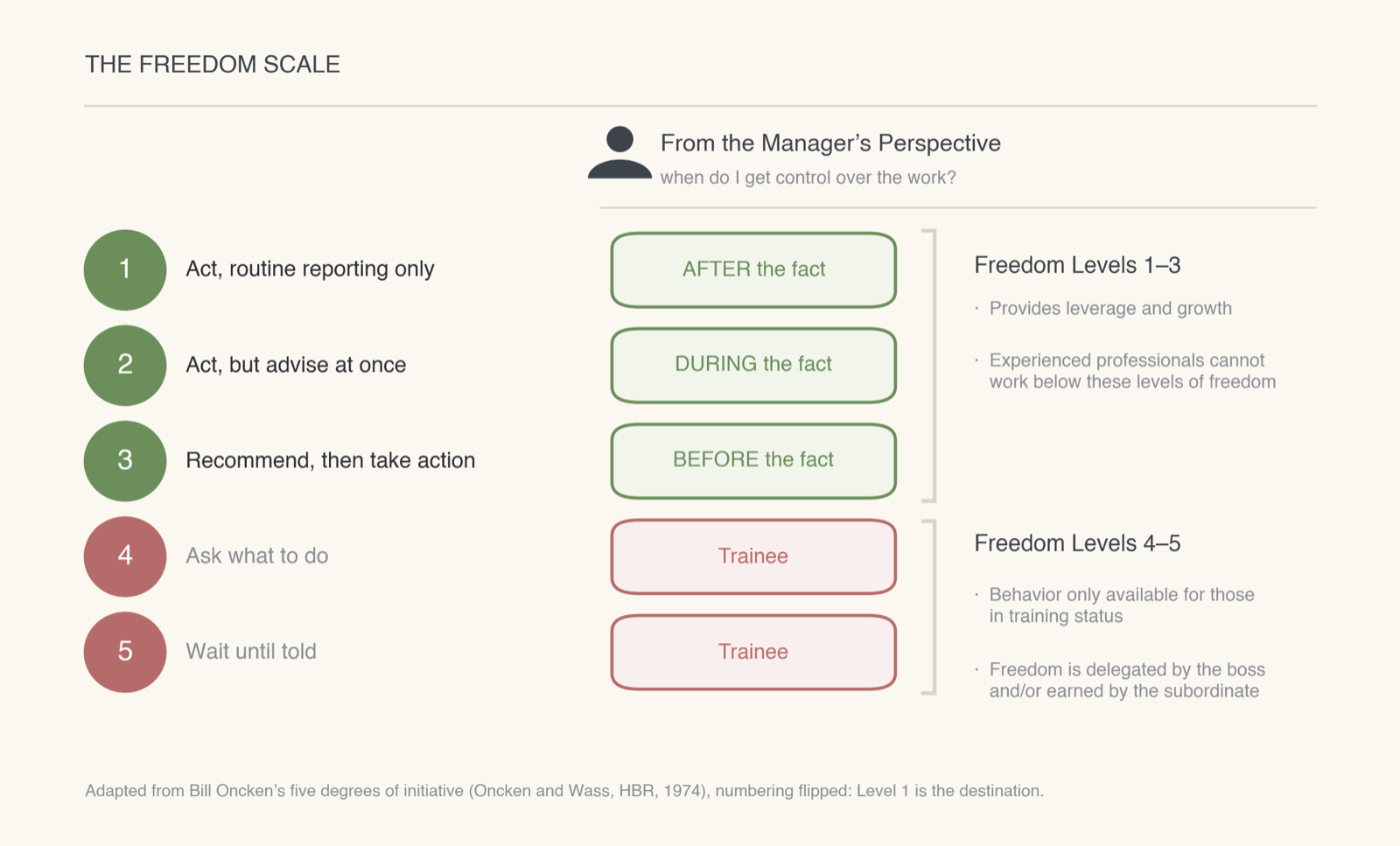
The levels have texture from the executive chair. Level 1 is the maximum-leverage state, and it is reserved: granted to the people who have demonstrated they take initiative and consistently deliver excellent work on time and on budget. Level 2 keeps a fast audit in play: the leader sees decisions as they happen, with an early shot at damage control when one goes wrong. Level 3 is fail-safe, and it bills the leader’s calendar for every decision, because someone has to read all those recommendations. And Levels 4 and 5 are time-boxed by design: Level 5 is for someone’s first day or two on the job, Level 4 for their first few weeks. Anyone seasoned who is still held there is being disempowered, by accident or on purpose.
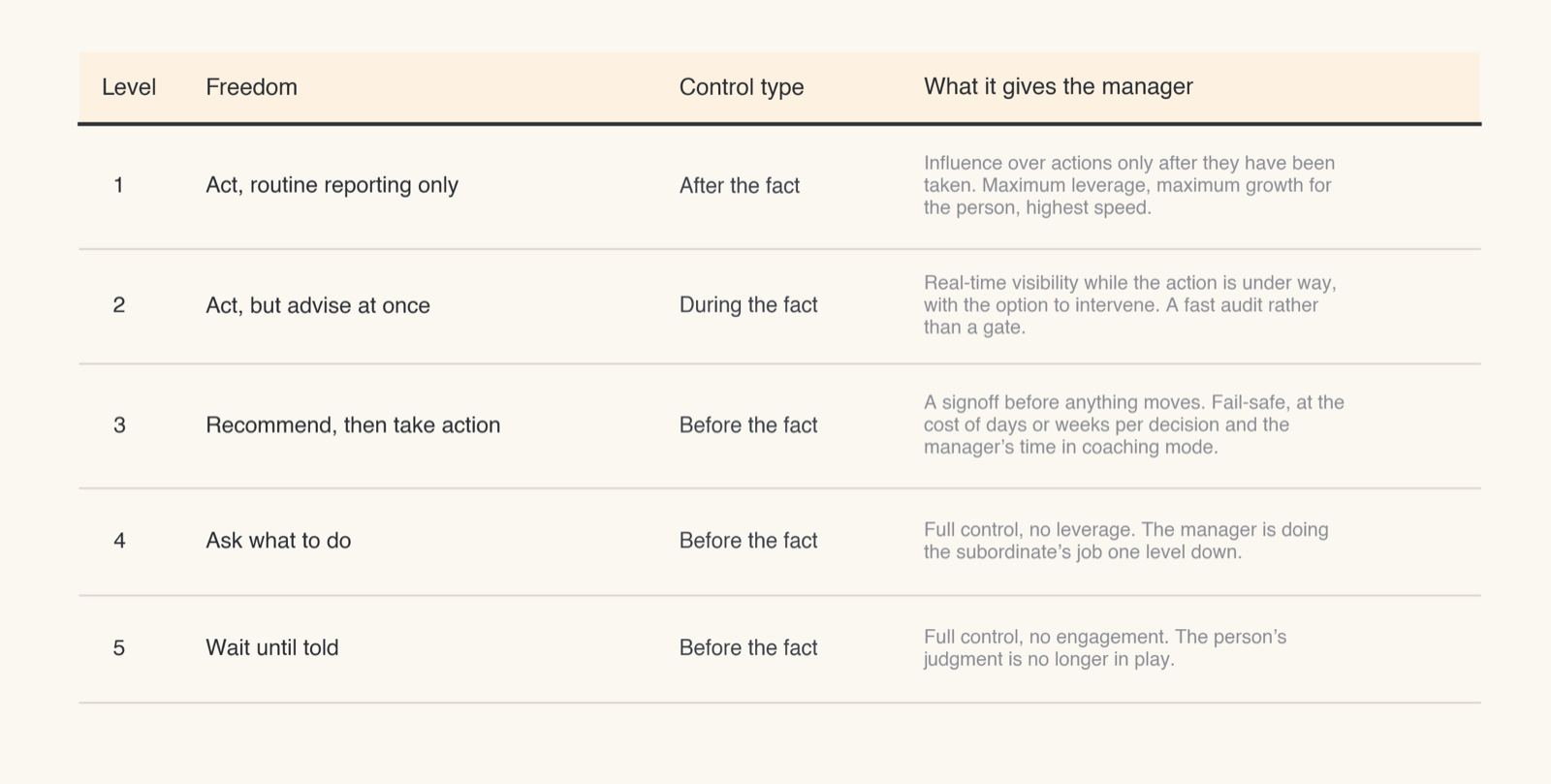
Read this way, the scale stops describing how confident the team is and starts describing how much control leadership is prepared to give up, and when. That is the honest variable, because it is the one leadership actually reacts to. The freedom scale is not a measure of the team. It is a measure of the boss.
Why leaders don’t empower
Leadership in many companies wants control before people act. Sometimes the reason is trust: they have been burned, or they never built the habit of judging results instead of approving plans. Sometimes it is a control need with a softer name: some leaders get pulled into Level 4 because they enjoy being needed, and it looks like caring. The same leaders are often threatened by Level 1 and Level 2 behavior. Either way the pattern is self-sealing. A leader who answers “what should I do” every time will keep being asked, and the arithmetic underneath is brutal: they are doing the work of the level below while being paid for the level above, which produces zero leverage for the organization. It is one of the biggest hidden causes of lost productivity we see, and it hides well, because the leader looks busy and close to the real work.
It gets worse on its own. High potentials will not work for a boss who lives inside their decisions, so they leave, and what remains is a team that needs the checking. Now the leader really is busy, the control really is necessary, and the rut has finished digging itself. Our Freedom to Act piece describes the disempowerment cycle from the subordinate side: the more you ask, the more you are told, and the closer you drift to Level 5. This is the same cycle, run from the top.
Hold teams at Levels 3 to 5 and the bill comes in threes. The teams will never be fast, because every trade-off waits for a recommendation to be read and a decision to be made. Leadership will never get leverage, because a senior professional held at Level 3 produces junior output at a senior salary. And the people will never develop, because nobody grows inside a signoff.
Empowerment and speed
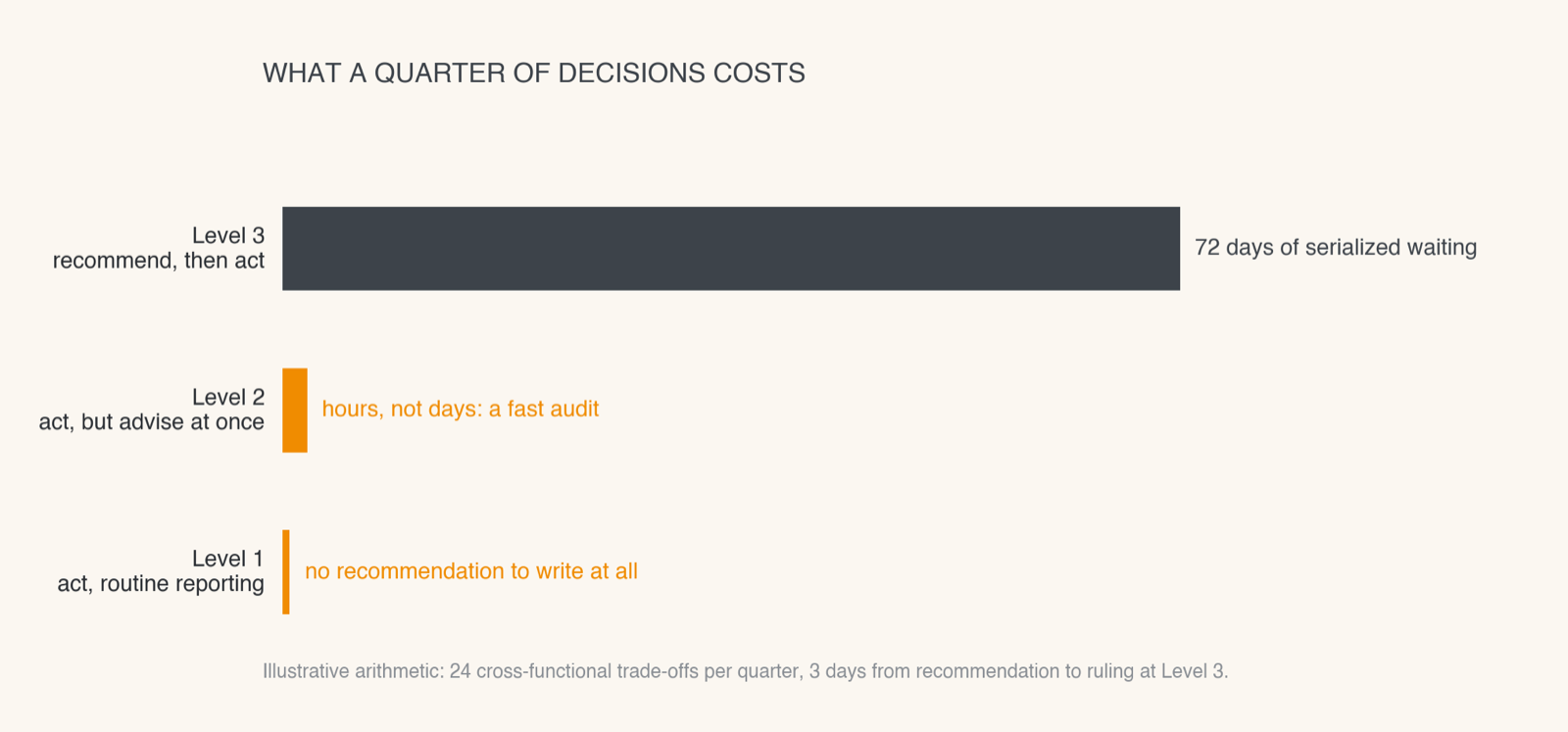
It is not so much about empowerment. It is about speed. Empowerment as a value rarely persuades an executive; a critical path does, so run the arithmetic. A cross-functional team makes a few dozen trade-off decisions in a quarter. Hold the team at Level 3 and every one of those decisions waits for the recommendation to be written, read, and ruled on: call it three days each, and twenty-four decisions cost you ten weeks of serialized waiting. Level 2 removes the wait entirely, because the team acts and advises at once. Level 1 removes the recommendation as well. That is the relationship between empowered teams and speed: the freedom level sets the decision latency, the decision latency multiplies across every decision on the program, and the product lands on your critical path. Slow decisions are the quietest way a fast program dies, and the freedom scale is the dial that sets the speed of every decision the team makes.
The idea is not new. Tannenbaum and Schmidt drew the continuum from boss-centered to team-centered leadership in Harvard Business Review in 1958. Sixty-eight years later, most organizations still operate at the boss-centered end while wondering why they are slow.
Why functions don’t release control
The third question has the same answer wearing a different badge. A functional manager is measured on control of a specialty: quality on defects caught, engineering on designs that work, finance on money that does not move without a signature. Releasing an engineer to a cross-functional team means trade-offs inside the specialty get made without the function’s signoff. Nothing in the function’s scoreboard pays for that, so the function holds the team at Level 3 and calls it governance. Blame the scoreboard, not the people playing to it.
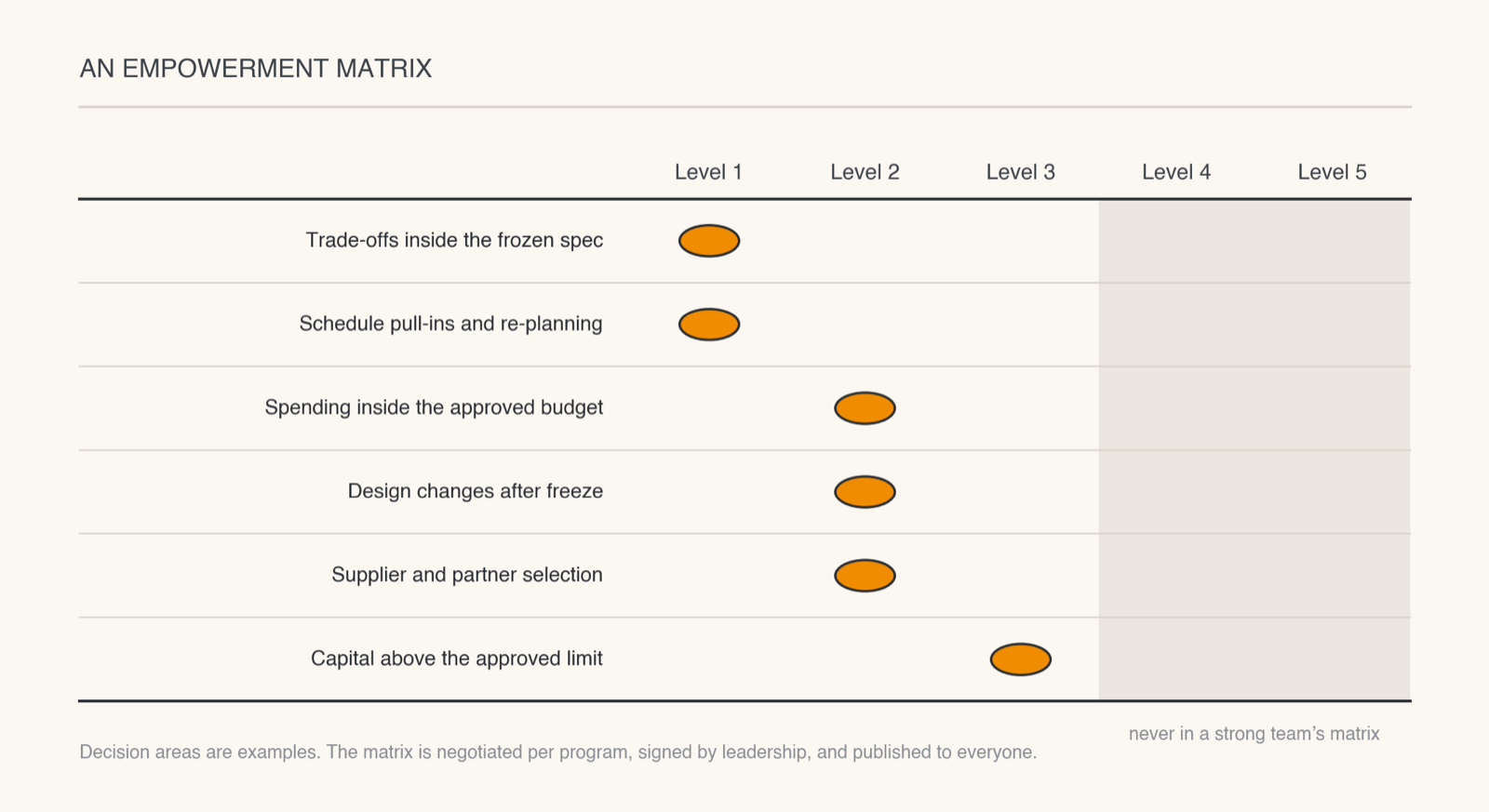
The fix is to make the trade explicit instead of fighting it one decision at a time. We use an empowerment matrix: list the decision areas on the program, assign a default freedom level to each, negotiate the cells where the function’s expectation and the team’s understanding differ, and publish the result so the envelope is visible to everyone. Freedom is granted per element of work, not per person: the same engineer can hold Level 1 on trade-offs inside the spec and Level 3 on capital. That is why the matrix has rows. Levels 4 and 5 do not appear in a strong team’s matrix at all. The act of writing the matrix is the act of empowerment, because it forces leadership to decide on paper, in advance, what it will let the team own.
The key point
Most empowerment programs aim at the wrong side of the desk. The key point is not so much what freedom level the team will take, but rather what freedom level leadership will give. Freedom is delegated by the boss, earned by the subordinate, or both, and a team that takes Level 1 into a hierarchy that insists on before-the-fact control will be pulled back to Level 3 within a quarter. Both sides have to move, and leadership moves first.
So put the scale in front of the leadership team, alone, and make them discuss it. The format is a working session: what leadership is prepared to grant, decision area by decision area, ending with a signed matrix. Expect a gap between the levels leadership believes it grants and the levels the team experiences; both sides overstate, which is why we have each side score the other, and why leadership should expect the team’s scores to come in one level lower than their own. And ease the transition with a habit we have watched fast teams use for decades: the UNIDIR convention, “unless otherwise directed, I intend to.” The team defaults to action while leadership keeps a window to object. David Marquet built a submarine command around the same sentence, “I intend to,” and wrote the story in Turn the Ship Around! (2012). It is the bridge from Level 3 to Level 2, and it costs nothing to adopt. There is an executive version of the scale for the org chart, too: promote the managers whose people race up it, and look hard at the ones whose people keep asking.
One more term of the trade, and it is the expensive one. Level 1 requires the executive to judge actions fairly after the fact, including the ones that turn out wrong. The first Level 1 decision that goes badly is the whole program: treat it as a learning event in public and the freedom holds; treat it as a punishable offense and every team watching returns to asking.
The trade, named
The freedom scale looks like a tool for developing subordinates. It is really a mirror for leadership: five levels, each naming how much control the boss is prepared to give up, and when. Teams cannot take more freedom than leadership is willing to give. Say what you will grant, decision area by decision area, sign it, and then hold the line the first time Level 1 costs you something. That is what empowerment is. Everything else is a poster.
Related reading: Freedom to Act, Before the fact leadership, Four questions every product leader should ask, The Product Boss owns the product; the Program Manager owns the plan, The host interrupt, and Reward performance. Don’t incentivize it.