A CEO looks at a two-year schedule and challenges the team to deliver in nine months. The team answers with an honest estimate built from everything it knows. Most organizations treat this as a conflict with a winner, and one side prevails: either the date is imposed and the team quietly disowns it, or the estimate stands and the company politely agrees to be slow. Both outcomes are the same failure. They collapse a productive tension into a single way of thinking.
Watch a fast product organization long enough and one trait keeps surfacing: its leaders and teams hold two contradictory ideas at the same time and act on both. Control and flexibility. Speed and quality. Frozen scope and a cadence of releases. Conventional organizations treat each pair as a dial with one setting. FTTM performers run both sides at full strength, and the discipline of doing so is what we call bimodal thinking: two states of the same thing, held by the same people, at the same time. It is unrelated to Gartner’s bimodal IT, which assigns different modes to different groups; this demands both modes from the same people. The sharpest and highest-stakes instance is the schedule.
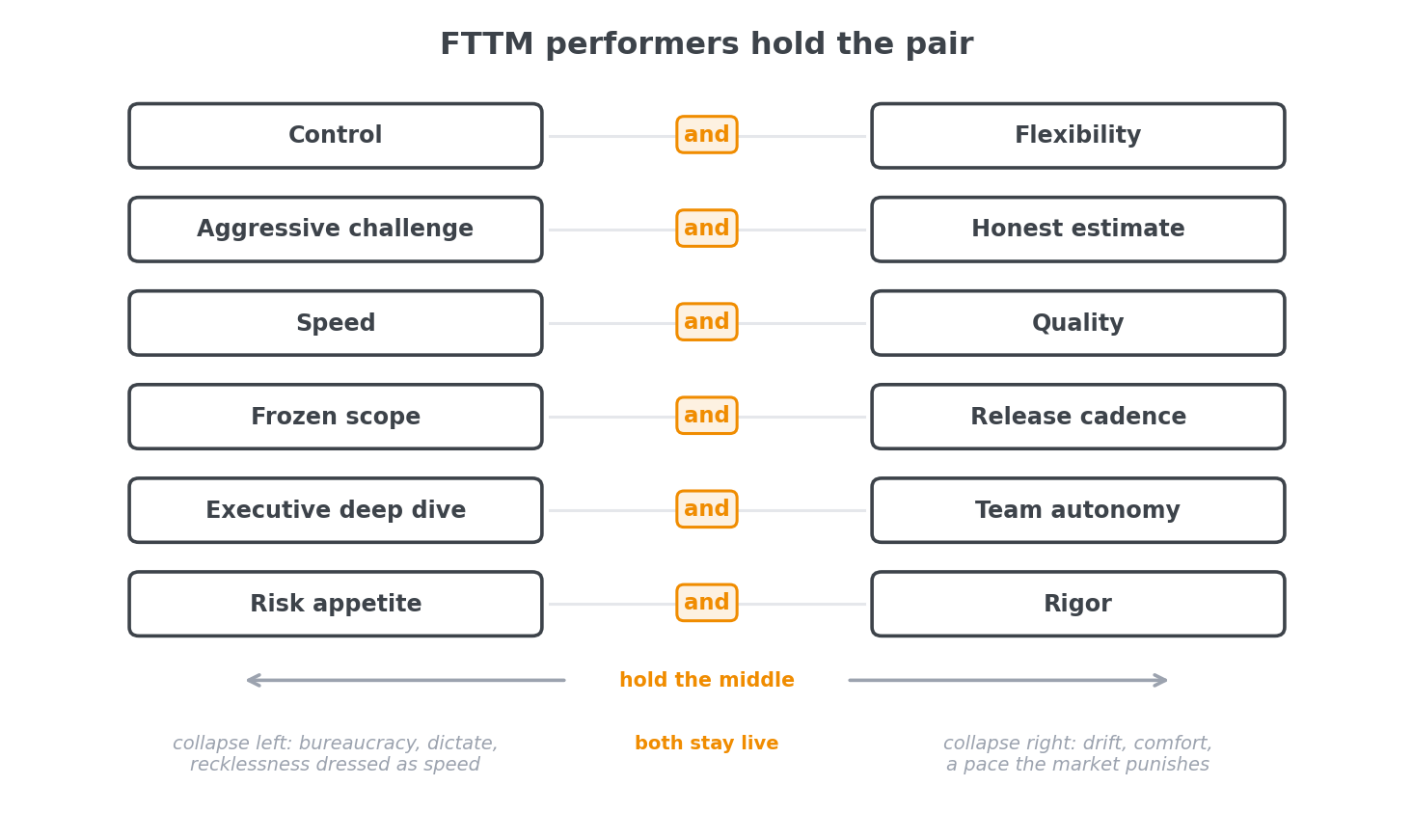
Two schedules, both true
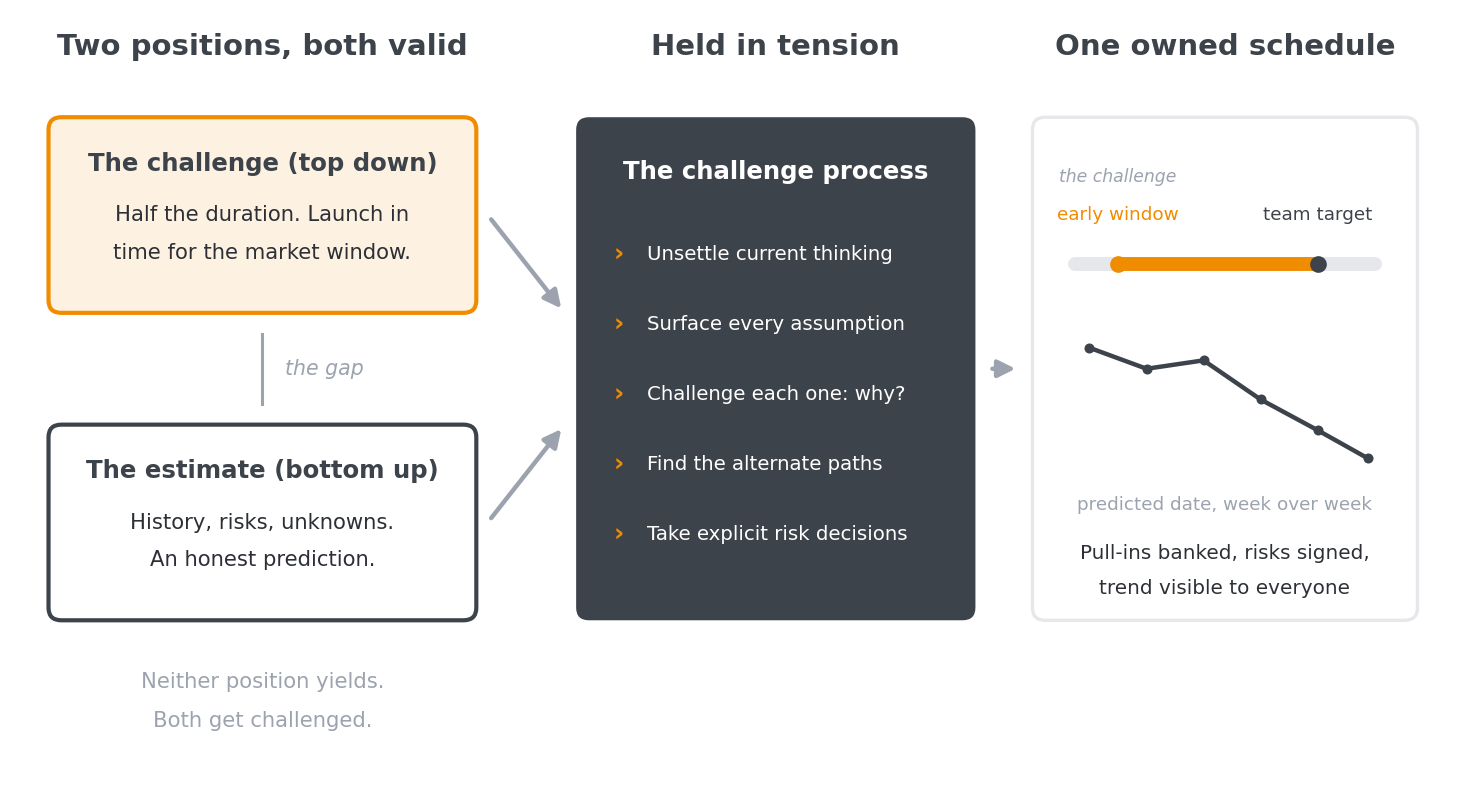
Mode one is the challenge. Leadership looks at the work from the outside and asks what the schedule would have to be for the business to win. This mode is deliberately unconstrained by the team’s history; it asks the question the inside view cannot ask. Mode two is the estimate. The team looks at the work from the inside and predicts what will happen, constrained by evidence: past cycle times, supplier lead times, the risks on the register, and the unknowns experience says will appear. An honest estimate is an asset. A schedule inflated to feel safe, or compressed to please the room, is a fiction, and a fiction cannot be optimized.
Holding both means treating each as legitimate, never as correct. In the field case below, the CEO’s challenge rationale failed a commercial fact check and the team’s honest estimate proved more than a year too long. Both positions were wrong, in opposite directions, and that is the point: each exists to expose the error in the other. The discipline is refusing to let either mode absorb the other. The challenge stays aggressive, the estimate stays honest, and the gap between them is named, measured, and worked down in public. On the schedule, the held pair becomes a window with dual targets: the challenge date as the early edge, the team’s commitment as the target, and the weekly trend read against the commitment.
Why the tension works
The practice converges with four independent bodies of research. Paradox theory says both/and beats either/or: Smith, Lewis, and Tushman found that leaders who hold contradictory demands outperform those who resolve them in one direction, and that under pressure organizations collapse toward a pole, where both poles underperform the held tension. Stretch-goal research explains the mechanism and carries the warning label: Sitkin and colleagues describe seemingly impossible targets as an autogenic crisis, a crisis the organization imposes on itself to force assumption-breaking search, and their research is blunt that stretch works in organizations with recent success and slack, and disorganizes the ones already failing. Forecasting science supplies the twist. Kahneman and Tversky’s planning fallacy says inside-view estimates run optimistic; in a slow product organization the reference class cuts the other way, and the outside view says the work should take half as long. The challenge is the outside view speaking. The estimate is the inside view speaking. Neither is complete, which is why both are heard and both are challenged. And lean deployment formalized the negotiation decades ago as catchball: leadership throws a breakthrough target down, the team throws constraints and counterproposals back, and the cycle repeats until both sides commit. Practitioners identify skipping catchball as the most common reason deployments die.
What the challenge actually does is put the team’s mind into what de Bono called an unstable state, the only condition under which people escape their normal line of thought. A comfortable team optimizes within its assumptions. A destabilized team has no choice except to attack them. The leader’s job is to create the instability and then protect the people inside it, because the protection is load-bearing: teams interrogate their own assumptions in public only where candor is safe.
Challenge, not dictate
The entire method lives or dies on one perceptual question: does the team hear a challenge or a dictate? The words can be identical. Our field notes from the case below captured it bluntly: we heard challenge, yet they heard dictate. What separates the two is observable behavior. The why travels with the date; a date without a rationale is a dictate by default, whatever the intention. The challenger goes to the schedule, not the status deck; in the field case the CEO installed the scheduling tool, took a tutorial, and learned to walk the critical path personally. Questions, never solutions; the moment the challenger specifies how, ownership transfers upward and dies there. The challenge accepts an answer; a schedule that survives an honest, all-out attempt to meet it is a validated schedule. And risk is signed from the top, so banked time can never later be turned against the team that banked it.
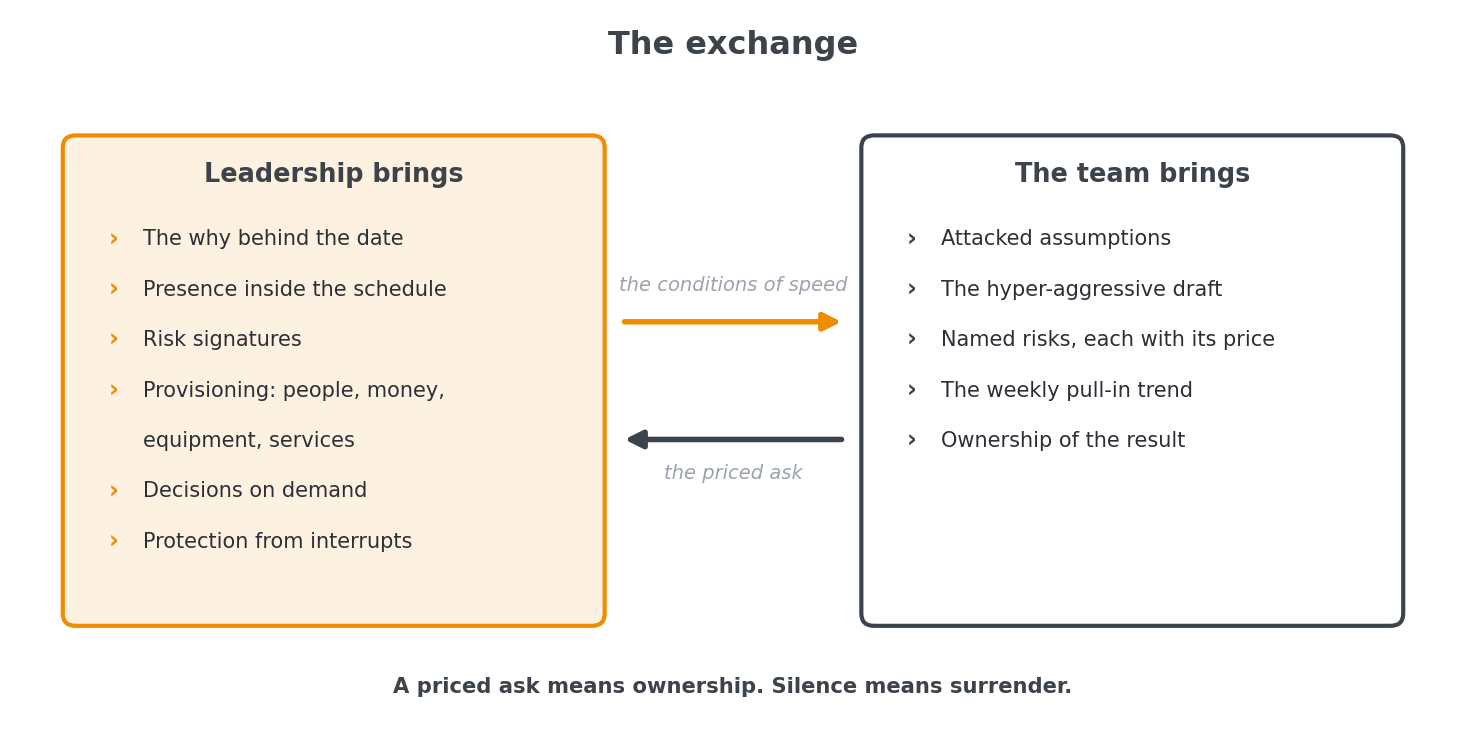
Done right, the drop-down opens an exchange no status review produces. The healthiest answer to a demand for speed is a priced one: if you want it faster, we need more risk signed and the provisioning to carry it. The moment the team names its price, the dynamic inverts. Leadership stops pushing a date down; the team starts negotiating the conditions of the date. The counter-ask doubles as the diagnostic: a team that names its price has taken ownership. Silence should worry a CEO far more than pushback.
The field case
The case is a mid-market hardware manufacturer running connected-product programs with an overseas ODM partner; identifiers have been removed, and the dates and durations are kept because they carry the point. The core project was, by the team’s own reading, an industrial-design refresh plus a wireless module: work everyone knew how to do. The plan of record ran well past two years. The CEO challenged the team to launch in roughly nine months, to intercept the next selling season.
The first reading was a dictate, and it produced hurt feelings and defensive meetings. Two things repaired it. First, the rationale was interrogated in the open, and the scrutiny corrected the challenge itself: the selling-season logic showed product had to leave the warehouse a full quarter earlier to reach shelves in time, which converted a single symbolic date into a launch window with dual targets. Second, the deep dive: the CEO began walking the critical path in the team’s own plan, asking why each driving task existed. What began as pressure from above became a shared examination of the same artifact.
Then the unstable state did its work. In a facilitated challenge workshop, the lateralworks working method for converting instability into banked schedule time, the team surfaced every assumption holding the schedule up and challenged each one with why. The tooling sequence was rebuilt. Formal prototype rounds collapsed. Certifications staggered by geography, launches staggered by market, features cut to the release cadence, the longest-lead components converted to signed risk buys, and a paid customer council became the alpha and beta population, which turned the most defensible objection to speed into an accelerant.
The lead program, already carrying a 156-day pull-in, drafted a plan pulling launch in a further 228 days: more than a year out of the schedule, moving it into the season the challenge named. A sister program located a plan 499 days earlier than its prior prediction. These are plan-level gains with launches still ahead, and the durability of each one rests on the signed risk log and the weekly trend that will show any giveback early. The workshop travels: three storage programs ran the same one-day session in 2014 and modeled a fifteen-month acceleration on one roadmap, with no added headcount and no relaxed requirements.
The decisive observation is about ownership. The compressed schedule was drafted, presented, and defended by the team, with the CEO’s own suggestions credited inside it, worth an estimated ten to twenty days, so the challenger owned part of the pull-in too. The team then invited the CEO into its reviews and shared more schedule data than he asked for. Executives back off when they see the team knows. The signature that bimodal thinking worked is audible in the pronouns: his date became our schedule.
The edges
The method has boundary conditions, and pretending otherwise would make this a sales pitch. The organization must be able to afford the crisis; stretch research is unambiguous that impossible targets energize winners and disorganize the failing, who are paradoxically the most tempted. The why must survive scrutiny; a rationale that collapses under examination and is enforced anyway is a dictate wearing a challenge’s clothes, and teams detect the costume instantly. Safety is load-bearing; the signed risk register converts protection from a promise into a document. And control must not eat the speed; every review added to protect the new pace trades some of it away, so the challenge process applies to the process itself. The instrument that keeps all of it honest is the same weekly trend: when the line stops falling, something is consuming the pull-in.
The question is never whether the top-down date or the bottom-up estimate is right. Both are, in the only senses that matter: the business needs the first, and the evidence supports the second. The organizations that move fastest hold that contradiction in working memory, week after week, and let the discomfort do the thinking. The tension is the method.
References: Smith, Lewis, and Tushman, “Both/And Leadership,” Harvard Business Review, 2016. Sitkin, See, Miller, Lawless, and Carton, The Paradox of Stretch Goals, Academy of Management Review, 2011. Sitkin, Miller, and See, “The Stretch Goal Paradox,” Harvard Business Review, 2017. The full twenty-two-item reference list is inside the white paper.
Related reading: Challenge the Assumptions, Escape the normal line of thought, Breakthroughs by challenging assumptions, Where targets come from, The monthly project deep-dive, Control systems don’t generate speed, Targets and Trends, and The FTTM execution system.