Last week we wrote in What leadership will give that teams cannot take more freedom than leadership is willing to give. This week, the other half of the bargain: freedom granted to people who cannot take it is just slack. An empowered fast team needs both a leadership that grants Levels 1 and 2 and people who operate there, and the second part is a selection problem, because you cannot train your way to a Level 1 team as fast as you can staff one. Jim Collins put the ordering plainly in Good to Great (2001): first who, then what. This article is the who, asked as the four questions every leader asks us once they have seen the freedom scale.
The seats we are filling are specific: a cross-functional new product development core team. That means a core team leader who will run the program at Level 1 inside a signed envelope, and core team members from engineering, manufacturing, marketing, quality, supply, and finance, each carrying their function’s authority into the room. Two of those words change the hiring problem. Cross-functional means most of your candidates already work for you, sitting inside functions, and the job is selection and release rather than recruiting. And core team means each member must hold two freedoms at once: freedom from their boss, and freedom from their function. Plenty of people have the first. The second is the rare one.
A one-paragraph refresher, and the article above has the full argument. The freedom scale runs from Level 5, wait until told, to Level 1, act with routine reporting only. Levels 1 and 2 are where experienced professionals live: maximum leverage for the leader, maximum growth and speed for the team. Levels 4 and 5 are trainee states, time-boxed to someone’s first days and weeks. The scale reads a candidate as well as it reads a team. Every candidate walks in already operating at some level. Your job is to find out which one before you put the program’s dates in their hands.
Where do I find them?
Inside first. For core team members, the Level 1 and 2 people are already on your payroll, and the functions know exactly who they are, even when the org chart does not. Ask three questions around the building. Who ships things without being chased? Whose name comes up in other departments? Who do the functional managers describe, with a slight edge in their voice, as hard to manage but always delivered? That edge is the sound of a Level 1 person straining against a Level 3 leash. Pull the rosters of the last fast program, the launch task force, the line-down recovery: the same names appear, and the people on those rosters volunteered. Level 1 people volunteer for cross-functional duty; Level 4 people are assigned to it.
Outside, for core team leaders and for the seats the functions cannot fill, three ponds. Your own Level 1 people’s referrals: they know each other, they cluster on fast programs, and a referral from one is worth a hundred applications because the referrer is staking their reputation on the verbs. Control-heavy companies: our Freedom to Act piece describes the disempowerment cycle, the more you ask the more you are told, and the best people inside an approval culture do not wait for the cycle to finish. They quietly disempower themselves or start looking. A company famous for signoffs is a recruiting pond; fish it. And the wreckage of fast programs: when a genuinely fast team breaks up through an acquisition or a site closure, the market briefly holds more Level 1 talent than usual. Move in weeks, because they go to each other first.
How do I know who they are?
The track record has a signature. The scale reserves Level 1 for people who take initiative and consistently deliver excellent work on time and on budget, so look for exactly that, in their words. Level 1 people tell stories in the first person with decisions in them: I decided, I shipped, I called the supplier, I moved the date. Lifelong Level 3 people tell stories with approvals in them: I recommended, I escalated, I presented options. Both can have the same title and the same résumé. The résumé tells you what they worked on. The verbs tell you what they did.
For core team seats, add two signatures. First, they are known outside their own function. Ask manufacturing about an engineer, ask marketing about a buyer: the strongest core team candidates are famous outside their own function, because acting at Level 1 on a product means crossing departmental lines, and people remember who crossed them. Second, they speak more than one function’s language. The engineer who can read a cost roll-up, the marketer who can read a schedule network, the buyer who understands a qualification plan. One language is a specialist; two or more is a core team member waiting to be selected.
And there is a tell that costs you nothing: watch what the candidate asks you. A Level 1 candidate interviews the boss. They ask what the team will own, how trade-offs get decided, what happens the first time they act and get it wrong, whether their functional manager can overrule the team. A Level 4 candidate asks about the reporting structure and the review cycle. The people you want are auditing your freedom scale from the other side of the table, because they have been burned by bosses who advertised empowerment and delivered approvals. Level 1 people interview the boss.
What questions should I ask?
Ask about the past, not the hypothetical. Anyone can describe what they would do; the freedom level lives in what they did. Geoff Smart and Randy Street built a whole method on this discipline in Who (2008): structured interviews about actual history, scored against a written scorecard. Ours is shorter, because we are scoring one variable, with two questions added for the cross-functional seats. Eight questions, and the scale does the scoring.
Tell me about the last decision you made without asking anyone. Tell me about a time you acted first and informed your boss after; what happened? Tell me about a time you acted on your own and were wrong; what did your boss do, and what did you do next? What did you do the last time you were told to wait? Walk me through a recommendation of yours that was refused; what did you do then? On your last program, how much of your work did you decide versus get assigned? Then the two cross-functional probes. Tell me about a trade-off you made between your function’s preference and the product’s schedule; who won, and who did you tell? And the sharpest one for a core team seat: in team meetings, what did you decide in the room, and what did you take back to your function first?
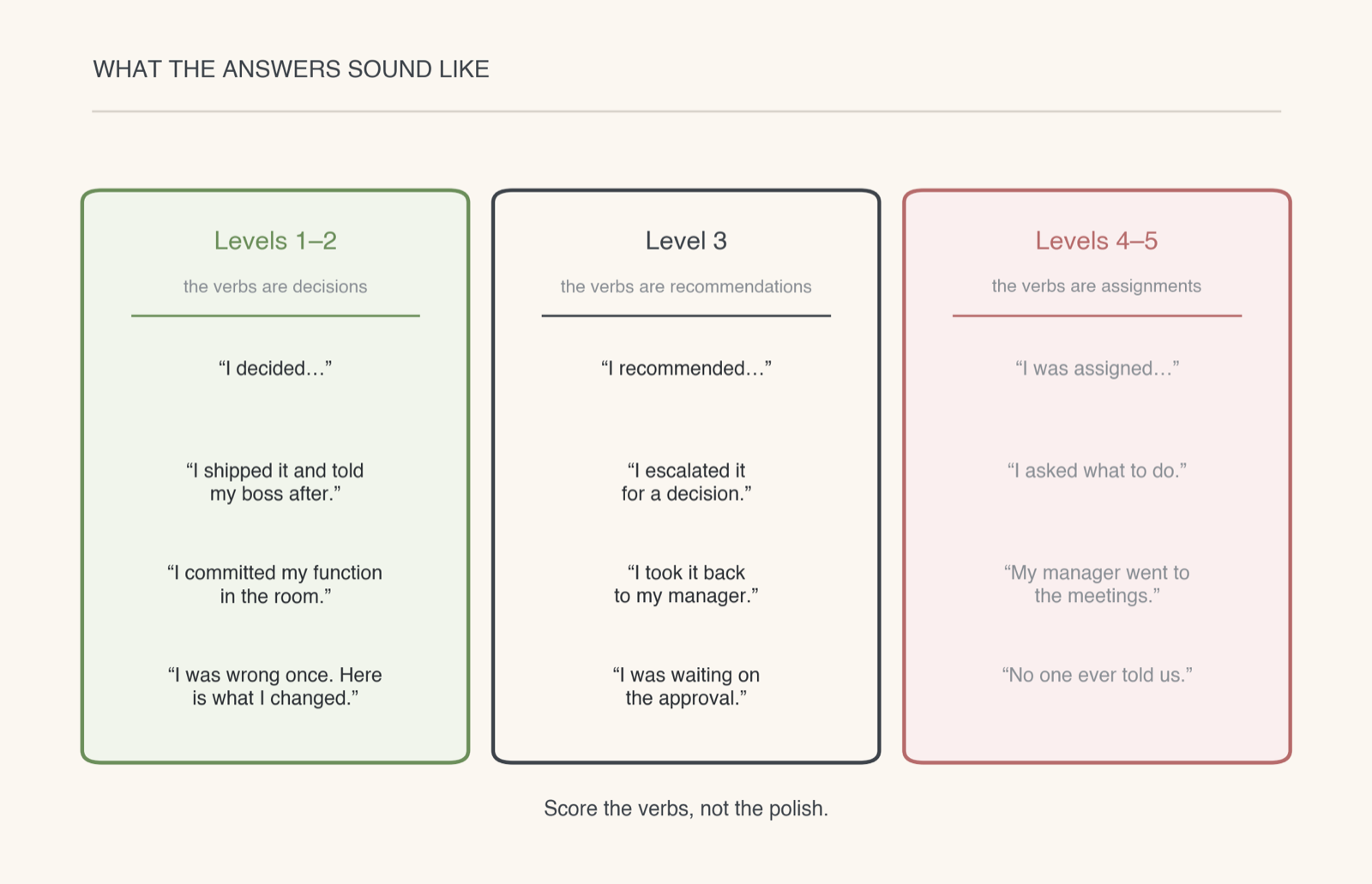
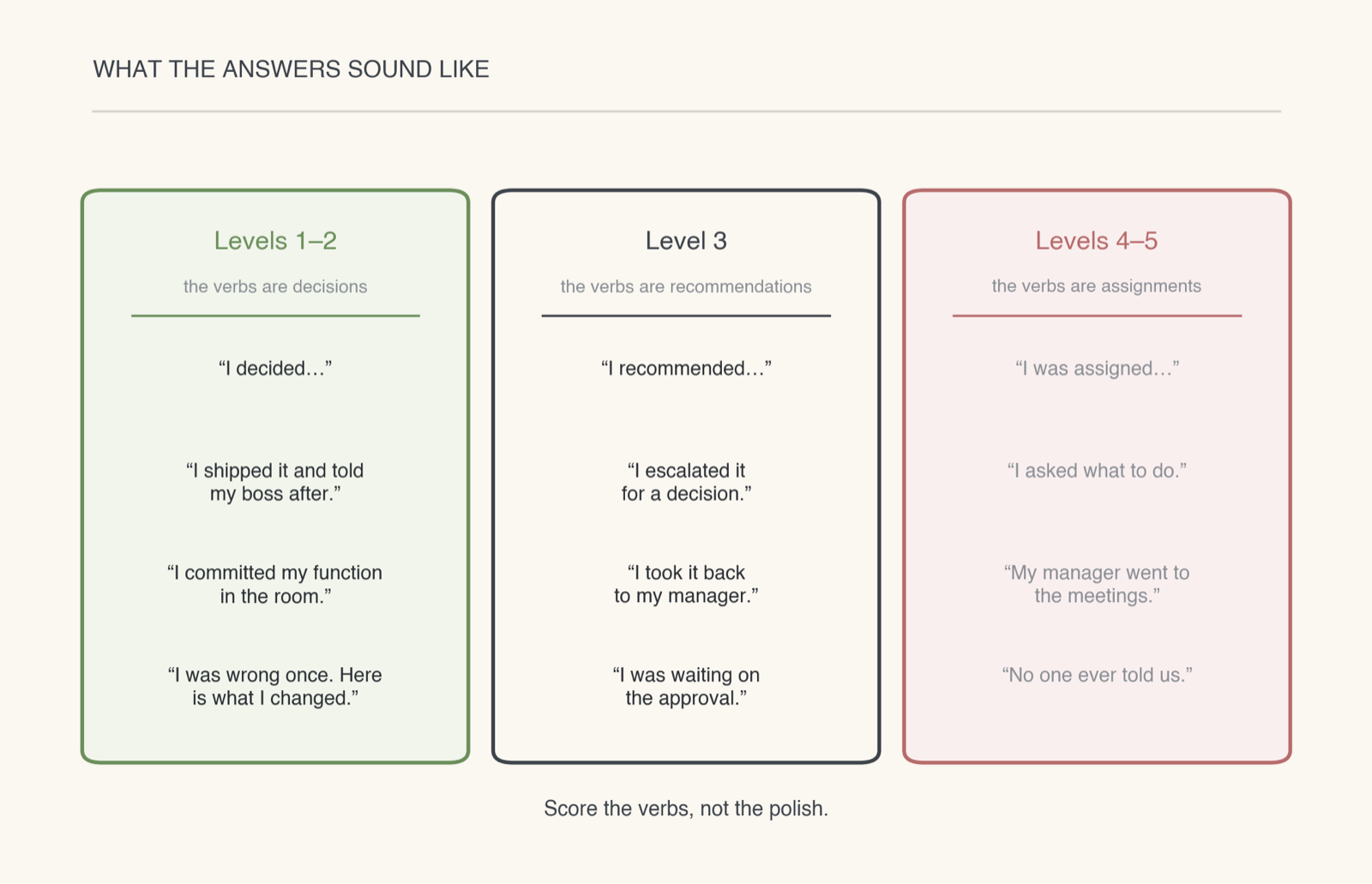
That last question is the whole cross-functional interview in one sentence. A core team runs at the speed of its slowest representative, and a member who takes every trade-off back to their function is not a team member. They are a messenger, and a meeting of messengers is a mailroom, not a core team. The answer you want sounds like UNIDIR, unless otherwise directed, I intend to: I committed my function in the room and informed my manager the same day. Score the verbs, not the polish. Decisions, commitments, and owned mistakes read as Levels 1 and 2. Recommendations, escalations, and take-it-backs read as Level 3. Assignments read as Levels 4 and 5. For the leader’s seat, our FTTM Managers piece describes the role’s skills and attributes, and Selecting FTTM Managers carries the longer selection instrument, eighteen attributes and a weighted decision model; the eight questions above are its freedom-level core, and the one-page version is the download below. Treat the vetting as a two-stage funnel: the freedom-level screen first, for every seat at the table; the full attribute profile second, for the leader’s.
How do I tell the lifelong Level 3 from the real thing?
This is the expensive miss, because the lifelong Level 3 candidate is often the more polished interview, and years in a matrixed organization teach a coordination language that sounds cross-functional while every actual decision went up a silo. Three tests cut through it.
The scar test. Nothing in a lifelong Level 3 history embarrasses them, and that is precisely the tell: a career of recommending means a signoff always stood between them and the consequence. The Level 1 veteran has been in trouble at least once, moved too fast at least once, been wrong in public at least once, and can tell you exactly what it taught them and what they changed. Ask for the scar. No scar, no Level 1.
The hero test. In a lifelong Level 3 story, the boss or the process is the hero; the candidate supplied inputs and the system decided. In a Level 1 story, the candidate owns the ending, good or bad, and the numbers are specific because they owned them. Listen for who decided in their proudest story. If it was a committee, you are hiring the committee.
The room test. Ask who they informed versus who they asked, function by function, on their last program. The matrix veteran asked everyone; it sounds like teamwork and it was actually permission. The Level 1 or 2 core team member informed most people and asked almost no one, and can name the one or two decisions that did belong above them. Knowing which decisions those were is not a weakness. It is the envelope working.
Then let the reference check finish the job. Do not ask former bosses whether the candidate was good. Ask: how often did they surprise you? Did you check their work? Would they act without you? A boss who answers “they never surprised me, I reviewed everything” is describing a Level 3 relationship, whichever of the two of them caused it, and one follow-up usually reveals which. For a core team seat, add one call to a peer in a different function: would you want them representing their function on your team again? The peer’s answer is the whole selection, compressed.
Level 1 is not a rebel
One more filter, because every executive raises it and they are right to. Hiring for initiative must not mean hiring people who disrespect authority, cut corners, or treat the company’s norms as optional. The goal is Level 1 and 2 people who make teams fast, not a revolution. The scale itself draws the line. Level 1 is act with routine reporting only, and the second half of that sentence is the discipline that buys the first half. A Level 1 professional acts without permission and never without informing. A rebel skips the informing.
The difference shows up in the envelope. Level 1 freedom lives inside a signed empowerment matrix: the Level 1 person knows exactly which decisions are theirs, works to the edges of that envelope, and when the envelope is wrong, renegotiates it openly rather than ignoring it quietly. We named this attribute in our 2019 profile of FTTM managers: the confidence to break rules within the system. “Within the system” is the whole distinction. They are also the easiest people in the company to govern after the fact, because the routine reporting actually arrives, on time, bad news first. The rebel recognizes no envelope, hides the miss, trades away quality for speed, and is proud of who they went around. One of these builds trust with every action they take; the other spends it.
Three screens separate them in an interview. In every acting-first story, listen for the informing: acted and told the boss the same day is Level 1; acted and nobody ever found out is a cowboy. In the scar story, listen for the ending: a Level 1 scar ends in learning and a changed behavior; a rebel scar ends in blame, or worse, in a repeat. And ask directly: tell me about a rule you disagreed with; what did you do? Challenged it openly, followed it while contesting it, or got it changed are keeper answers. Quietly ignored it is not, however good the outcome was. Then ask where they would never trade speed: a candidate with a ready answer about quality, safety, or the customer has an internal governor; a candidate with no answer is fast the way a car with no brakes is fast.
Keeping them is the same problem
Retention is the freedom scale again. You recruit Level 1 people with money; you keep them with freedom. Put the team’s decision areas in a signed empowerment matrix in the first month, so the authority they interviewed for is on paper. Release them for real: staffed means named by the functional manager and released to the team, and a Level 1 person given a core team seat with no released time has been handed a second job, not a promotion. Do not let the functions audit them; a member whose manager re-reviews every team decision is back at Level 3 within a quarter, and our piece on the Product Boss and the Program Manager covers why the partnership fails when either side audits the other’s domain. Hold the trust exchange when the first Level 1 decision goes wrong: a public learning event keeps them, a punishment converts them into a Level 3 employee who is also updating their résumé. And reward the performance you hired for rather than incentivizing compliance; we wrote about that trade in Reward performance. Don’t incentivize it. Experienced professionals cannot work below Levels 1 and 2. Hold one there and you have not lowered their level. You have started their job search.
Hire for the verbs
The résumé tells you what someone worked on. The freedom level tells you how they worked, and how fast they will work for you. Look inside first, where the functions already know who ships. Listen for decisions instead of recommendations, for commitments made in the room instead of taken back up the silo. Ask for the past instead of the hypothetical, demand the scar, screen out the rebel, call the peer in the other function, and then keep the promise your interview made. A core team selected this way arrives already fast. Everything else is training, and training takes quarters your program does not have.
Related reading: What leadership will give, Freedom to Act, Selecting FTTM Managers, FTTM Managers, Integrated Core Team, Fast Autonomous Teams, Measure FTTM Team Maturity, The Product Boss owns the product; the Program Manager owns the plan, and Reward performance. Don’t incentivize it.