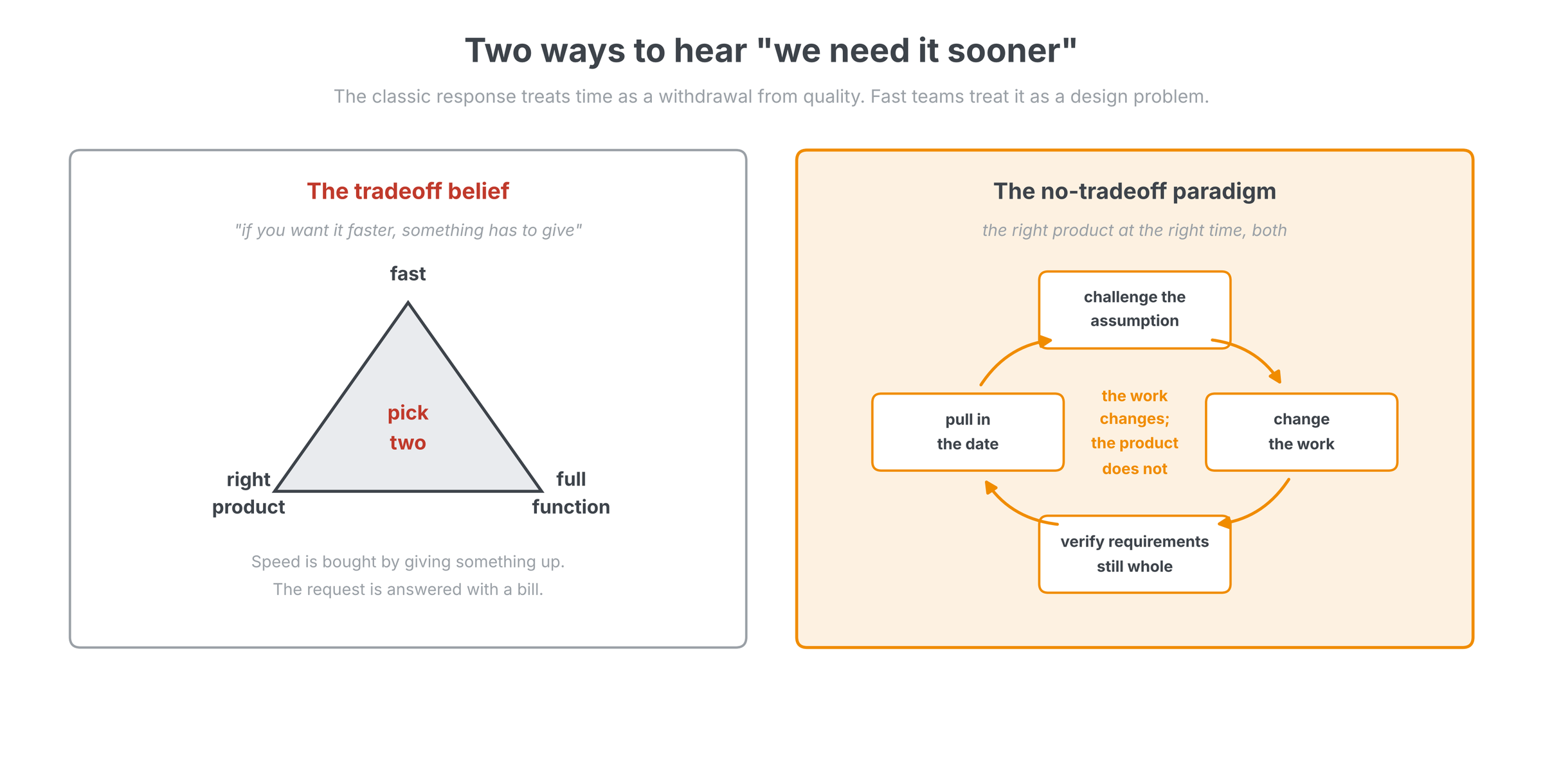
"If you want it faster, something has to be compromised." Every development leader has heard this sentence, and most have said it. It arrives dressed as physics: the triangle on the whiteboard, speed on one corner, the product on the others, pick two. It sounds like hard-won wisdom. It is actually a habit of mind, and in most organizations nobody can remember deciding to adopt it.
Our best-practice research across fast development teams found something different. The fastest teams do not think in tradeoffs at all. We call what they do instead the no-tradeoff paradigm: going fast does not mean releasing a bad product. Fast teams know they can go fast and develop the right product, and they want both, the right product at the right time. It is a mindset before it is a method, and teams that have never worked this way assume going fast must mean cutting corners, because that is the only version of fast they have ever seen.
The no-tradeoff paradigm
Watch what the mindset does when someone asks for speed. It does not reach for the scope lever or the quality lever, because those are not levers, they are the product. It looks for acceleration opportunities instead, or changes the work itself so the same requirements are met by a shorter route, and it verifies at every step that the customer requirements are still achieved in full. The compromise everyone offers becomes the first assumption to challenge. This is bimodal thinking applied to the schedule: holding two demands at once, refusing to resolve the tension by surrendering one of them, and letting the tension do the creative work.
The software world has now run this experiment at a scale nobody else can match. Google's DORA program spent a decade measuring thousands of technology organizations, expecting to find the familiar bargain between how fast teams ship and how often things break. Instead, in its own words, "the research debunked the myth that speed comes at the expense of stability, finding that high performers excelled at both." Speed and quality moved together, because the same disciplines produce both. The slow organizations were not safer. They were just slower.
Slow is not careful
Here is an uncomfortable pairing from the road-safety data. Germany's motorways famously include long stretches with no posted speed limit, and Germany loses 3.4 people per 100,000 to road deaths in a year. The United States, which drives far slower, loses 12.2, according to the OECD's IRTAD 2024 road safety report. Road safety has many causes and this is not an argument about traffic policy. It is an observation about attention: the driver moving fast is paying attention, because speed demands it. The faster you go, the more you pay attention. Speed and care are not opposites; on a well-run program they are the same discipline, each enforcing the other.
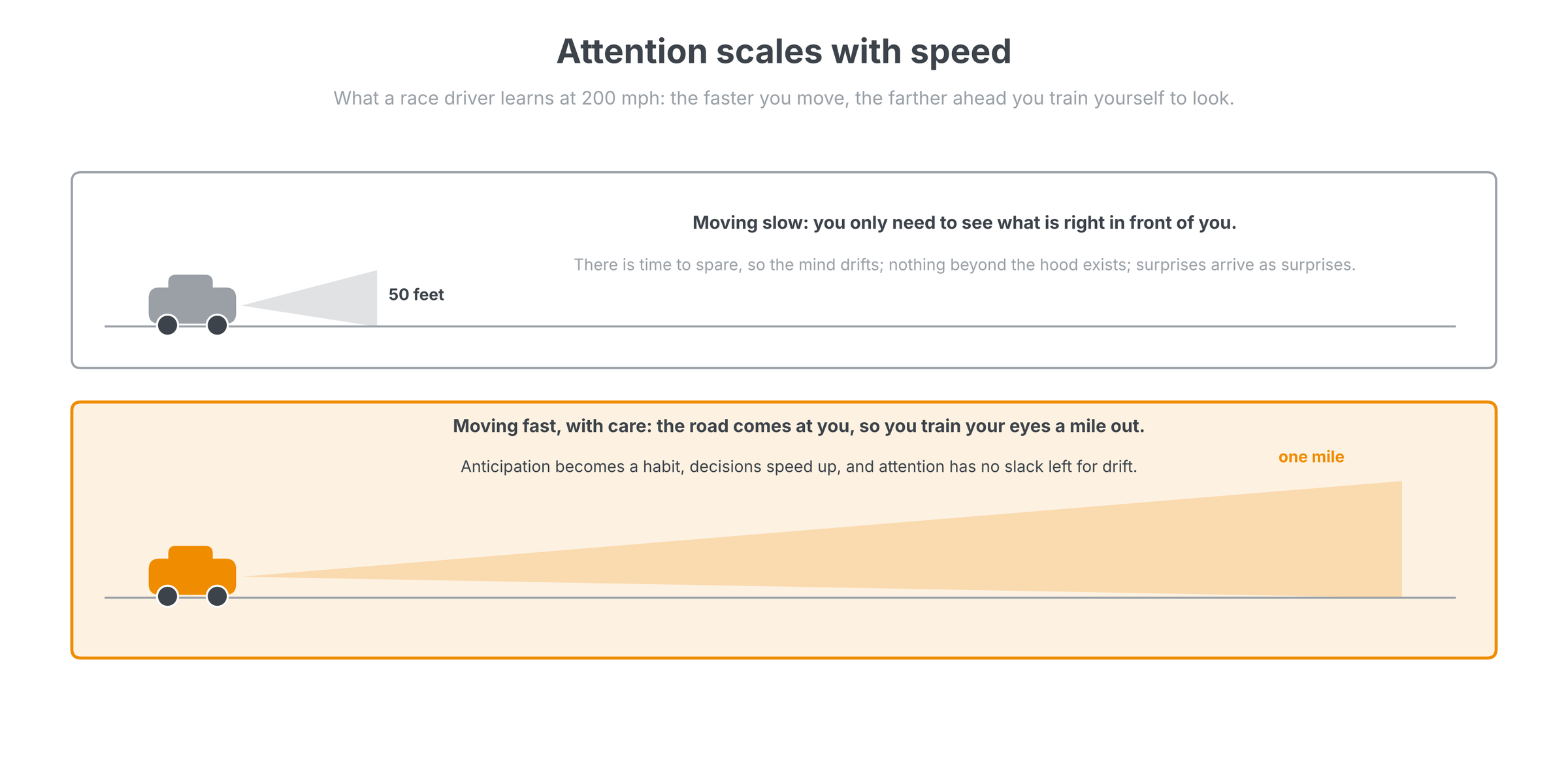
A client of ours raced Formula 2 cars earlier in his life, and his description of driving at 200 mph is the best account of the fast mindset we have heard. At that speed you look a mile ahead, because the road is coming at you so fast; you train your eyes to see beyond your normal vision space, you train yourself to anticipate quickly, and your whole decision-making process speeds up to match. Then the reverse, which is the part most people never consider: when you drive slow, you only need to look fifty feet ahead, so that is all you look. You miss everything beyond it, you cannot anticipate, and because there is time to spare, you drift and think of other things. Slow does not buy care. Slow buys slack, and slack gets spent on defocus.
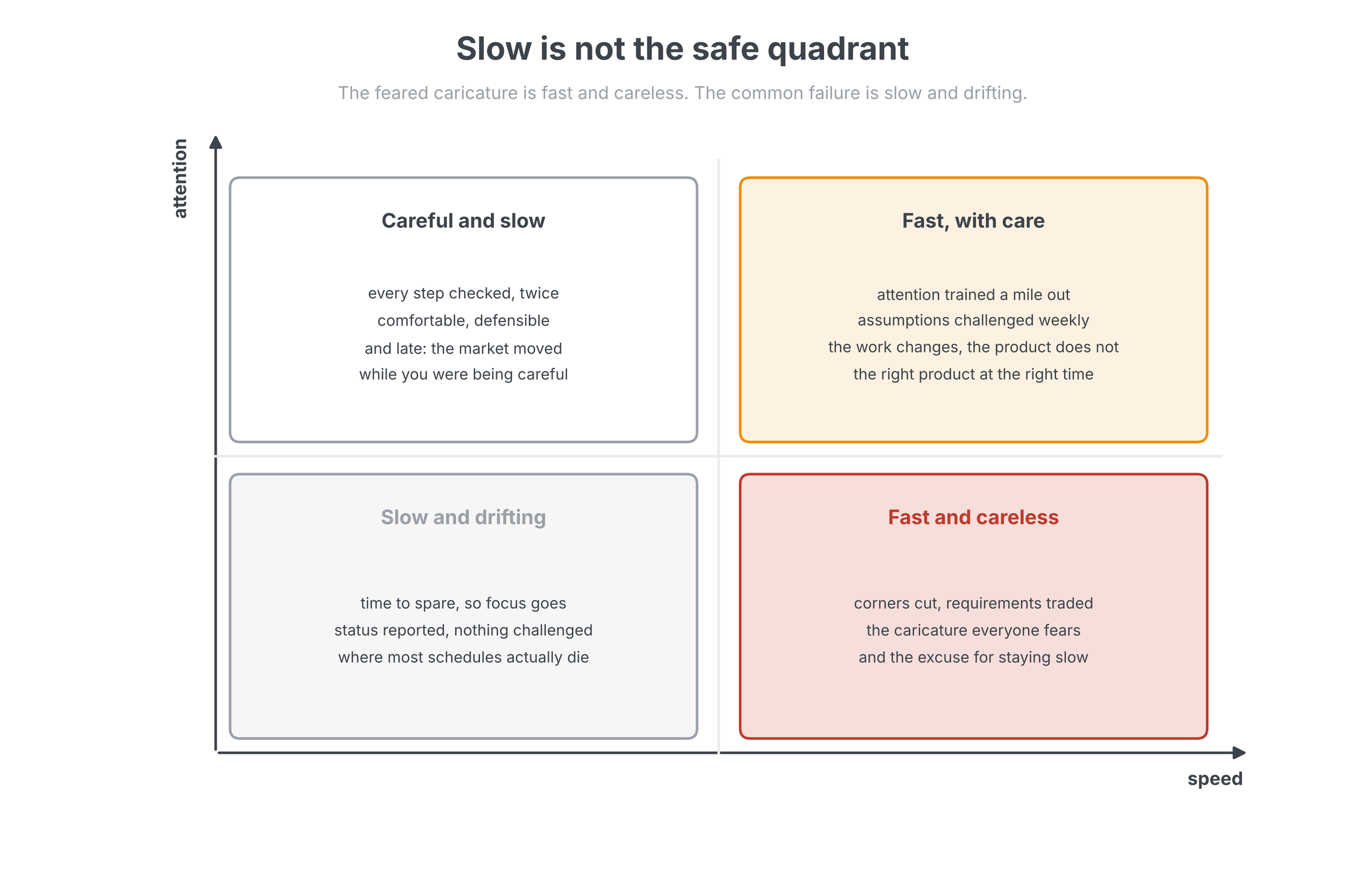
Map that onto development programs and the familiar quadrant chart rearranges itself. The caricature everyone fears, fast and careless, is real but rare, and it mostly serves as the excuse for staying slow. The common failure is the opposite corner: slow and drifting, where there is time to spare, status gets reported, nothing gets challenged, and the schedule dies of inattention. Careful-and-slow, the quadrant that feels responsible, delivers a well-checked product into a market that moved. The quadrant worth living in is fast with care, and the fast is what produces the care.
Going fast does not mean releasing a bad product
Fast teams refuse the choice. They change the work until the right product arrives at the right time, and they treat the compromise everyone offers as the first assumption to challenge.
Where the mindset gets built
This quarter we watched a CEO build this mindset in a team, in person. The programs in question are new product developments that are mission critical to the company's future, and the CEO went deep into them, project by project, inside the weekly refresh meetings. Not to collect status; the schedule already carries status. The purpose was teaching: how to pull in a schedule rather than simply report progress against it, how to challenge the assumptions inside each task to find another way to do the work faster, and how to do all of it while protecting the end product completely. It was mentoring, with a live schedule as the textbook, and coming from the chief executive it carried a message no memo could: this is how I want you to think.
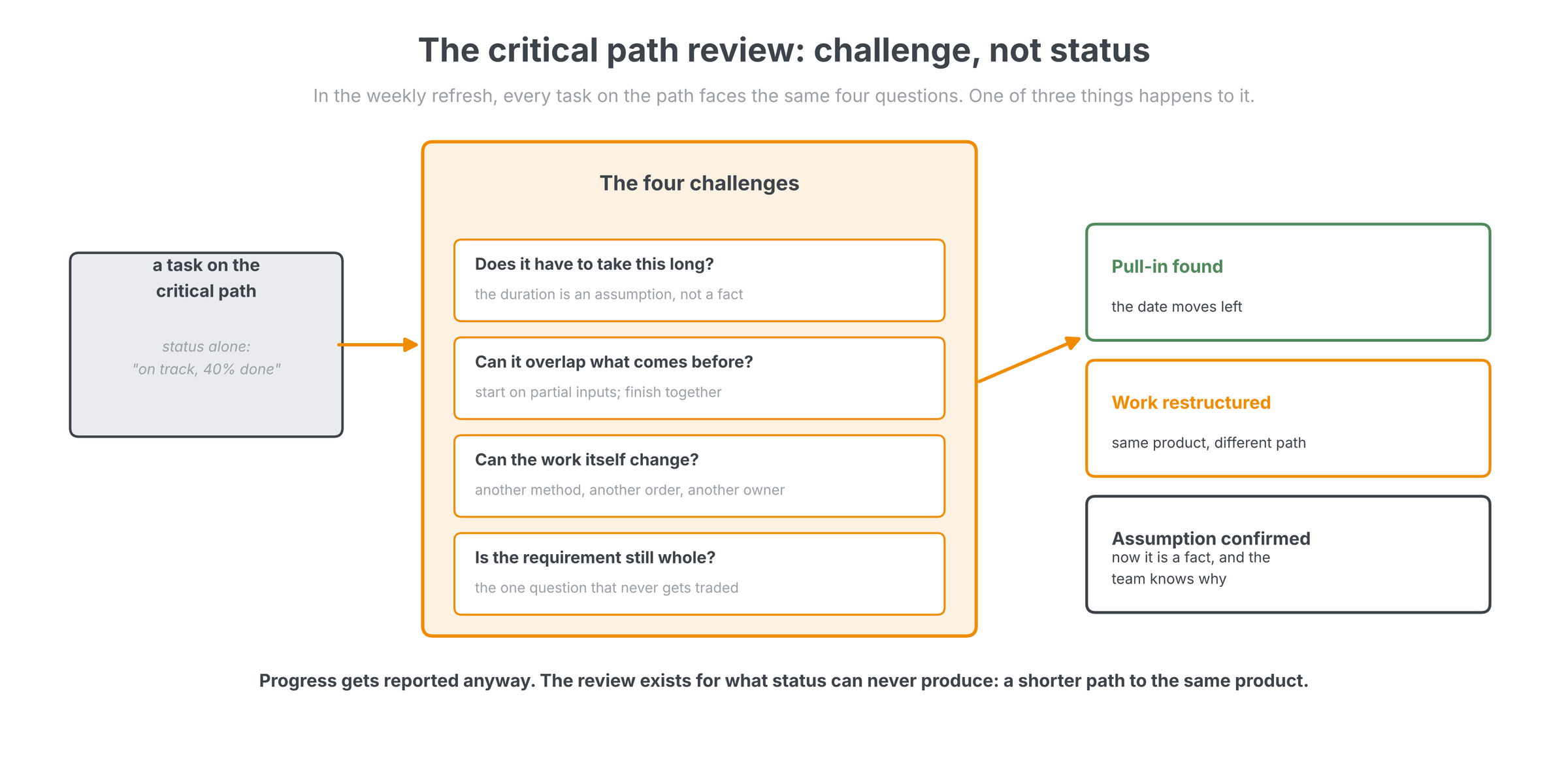
The vehicle for that teaching is the critical path review, a core part of our refresh planning methodology. Each week, in the schedule refresh, the near-term critical path comes up on the screen and every task on it faces the same four challenges. Does it have to take this long? Can it overlap what comes before it? Can the work itself change: another method, another order, another owner? And the question that never gets traded: is the requirement still whole? One of three things happens to every task. A pull-in is found and the date moves left. The work gets restructured, same product by a different path. Or the assumption survives the challenge and becomes a fact the whole team understands. We have written about the challenge process and what the critical paths tend to hide; the review is where both habits get practiced until they are reflexes.
Notice what repetition does. When the leader asks "can these two overlap?" every single week, teams stop waiting to be asked. They arrive having already challenged their own durations, because they know the questions are coming and because they have watched the questions work. That is how a mindset propagates: not by announcement but by a cadence of questions asked against the plan, week after week, until the team hears the questions in its own voice. Time a leader invests in this now pays off later as a more aggressive mindset across every development team they touch.
Pay attention
The no-tradeoff paradigm is not bravado, and it is not a demand to simply try harder. It is trainable, the way the driver's eyes were trainable. Choose speed, then build the attention that speed demands: the weekly refresh, the live critical path, the four challenges, the requirement held whole while everything else is allowed to change. Teams that work this way get the right product at the right time, and they get something else as a side effect: they are more careful than the slow teams, because their speed leaves no room for drift. Careful-and-slow concedes the race before it starts, and it is not even careful. Fast, with care, is one thing, not two. The faster you go, the more you pay attention.
Related on lateralworks: Break it down together and What causes delay?