Most programs that miss their dates had a schedule. Many had a good one. The failure was not in the network logic or the critical path math; it was in the gap between the schedule and the calendar. A schedule breaks down the moment its tasks are not translated into specific activities and actions for specific individuals in a specific week. The integrated master schedule knows what has to happen by Friday. If the people doing the work find that out at the postmortem, the schedule governed nothing. It was a prediction, not a plan.
Where schedules break down
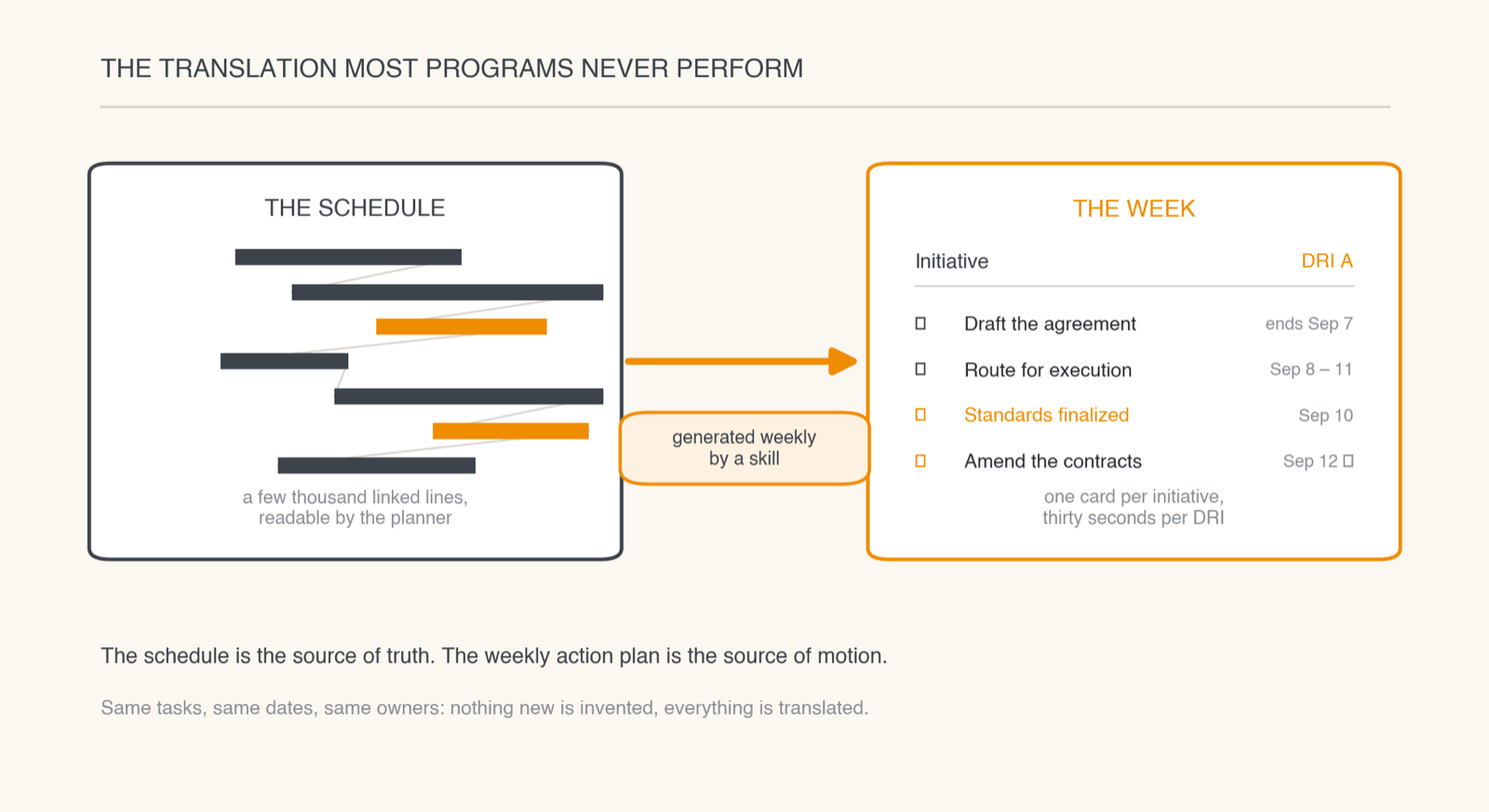
The schedule lives in scheduling software, a few thousand linked lines deep, readable by the planner and almost nobody else. The team lives in calendars, inboxes, and ticket queues. Between those two worlds sits a translation that most programs never perform: this week, these tasks, these owners, these dates. Without it, people work on what is loudest instead of what is next on the critical path, tasks that were supposed to start on Monday quietly start on Thursday, and the slips are invisible until the next full schedule update, weeks later. We wrote in The weekly schedule refresh that a schedule updated weekly stays honest. This is the other half of that discipline: a schedule translated weekly stays executed. The schedule is the source of truth. The weekly action plan is the source of motion.
The translation
The translation is a one-page view, regenerated from the schedule at every refresh, that answers one question for every leader on the program: what does my team do over the next two weeks? It is grouped the way the program is actually run, one card per initiative, with the DRI, the Directly Responsible Individual, named at the top of each card. Every task in the window appears with its dates. Milestones due in the window are flagged. Program targets are flagged harder. A week-at-a-glance block totals the motion: how many tasks are in flight, how many start, how many finish, how many milestones come due. Nothing in it is new information. Every line is already in the schedule. The value is that a DRI reads their card in thirty seconds on Monday morning and knows their week, without opening the scheduling tool, without asking the program manager, and without being surprised on Friday.
The example
The download is one such translation, from a live cost reduction program, client identifiers removed. The program is structured the way we build them: a series of individual cost reduction initiatives, eleven in this case, each run as its own small project with a DRI who owns it end to end. BOM cost, freight, cloud compute and storage, maintenance expense, contractor contracts, installation efficiency, financial allocations. One page shows the whole program’s next two weeks: 49 tasks in motion, 14 starting, 26 finishing, 7 milestones due, and the one program target due in the window, flagged on its card and again in the summary. A leadership team can walk this page in ten minutes on Monday. Each DRI needs only their card.
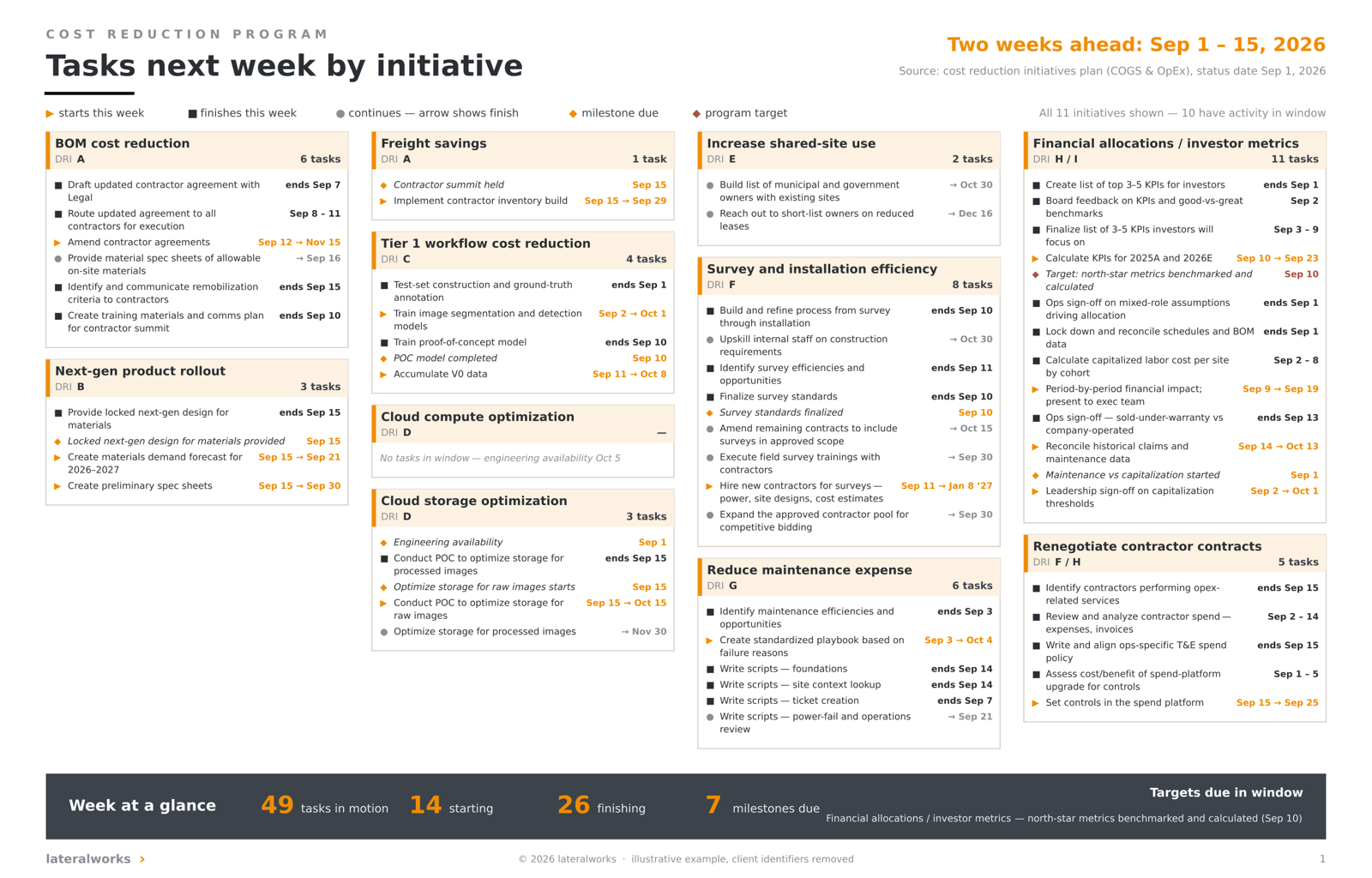
Look at what the page makes visible that the schedule hides in plain sight. One initiative has no tasks in the window at all, and says so, with the date its engineering capacity arrives. That is not an empty card; it is an answer to a question an executive would otherwise ask in a meeting. Two initiatives share a DRI, which is a load question you can see. And the milestones due carry names and dates, so Friday’s review is a checklist, not an archaeology dig.
Built by a skill, not by hand
Nobody should maintain this document by hand, because a hand-maintained action plan and the schedule diverge within a week, and then the program has two versions of the truth. We built a Claude Skill that converts the critical path schedule export into this page directly: it reads the plan, filters to the window, groups by initiative, attaches the DRIs, flags the milestones and targets, and lays out the page in the house format. Regenerating it after each weekly refresh takes a minute, so the action plan is always exactly as current as the schedule it came from, and the translation that most programs never perform becomes a step nobody has to remember. We described the pattern in How lateralworks uses AI: the tools do the assembly, the team does the review. If the action plan is maintained by hand, it is already wrong.
The practice
The rhythm is weekly and it closes a loop. Refresh the schedule with the team, which captures actuals and re-runs the dates. Regenerate the action plan from the refreshed schedule. Each DRI runs their week from their card, and raises the flag the day a task will not start, not at the next refresh. Review the milestones due at the end of the window against what actually happened. Then refresh again. The schedule stays honest because it is updated weekly; the week stays honest because it is translated weekly; and the two never drift apart because one is generated from the other. Churchill pinned “Action this day” to the papers that could not wait. A weekly action plan is that label, applied by the critical path instead of by rank.
The gap is the failure mode
Programs rarely fail in the scheduling tool. They fail in the seven days between one update and the next, when the plan said start and nobody’s calendar agreed. Translate the schedule into the team’s week, every week, generated rather than transcribed, and the critical path stops being a report the planner owns and becomes the week the team runs. The schedule tells you the date. The Monday-morning page is how you make it.
Related reading: The weekly schedule refresh, The rhythm of accountability, Action this day, Start with a macro plan, My schedule keeps slipping, Buffer erosion, and How lateralworks uses AI.
Downloads
- Tasks next week by initiative: a two-week action plan generated from a live cost reduction program’s critical path schedule, one page, client identifiers removed (PDF)
- Tasks next two weeks: the same one-page action plan for a new product development program, twelve project elements, critical path in red, company identifiers removed (PDF)