← Results·

17 case studies. Field-tested.

Real engagements from the lateralworks team across semiconductor, hardware, and complex-systems programs. Names and sector-identifying details have been removed. New cases added regularly — check back.

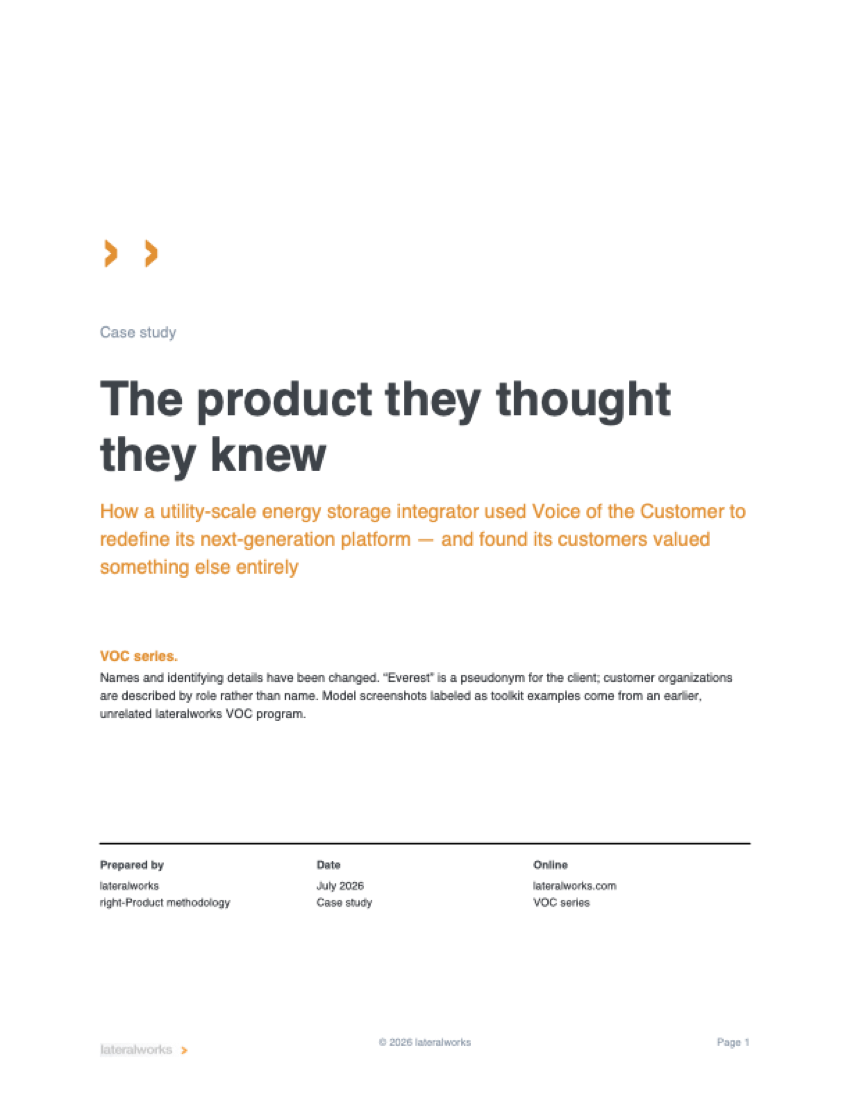
Cover of The product they thought they knew
Client Projects·Case study·Grid-scale energy storage

The product they thought they knew

How a utility-scale energy storage integrator used Voice of the Customer to redefine its next-generation platform — and found its customers valued something else entirely

Core thesis. Everest’s internal product concept was coherent, technically sophisticated, and wrong in two of its central assumptions. A VOC council, structured discovery, and AHP pairwise prioritization let customers re-rank the company’s priorities before the capital was committed — and revealed that in a deflating hardware market, the differentiated product is availability itself, delivered and proven by software.

July 8, 2026·28 pages
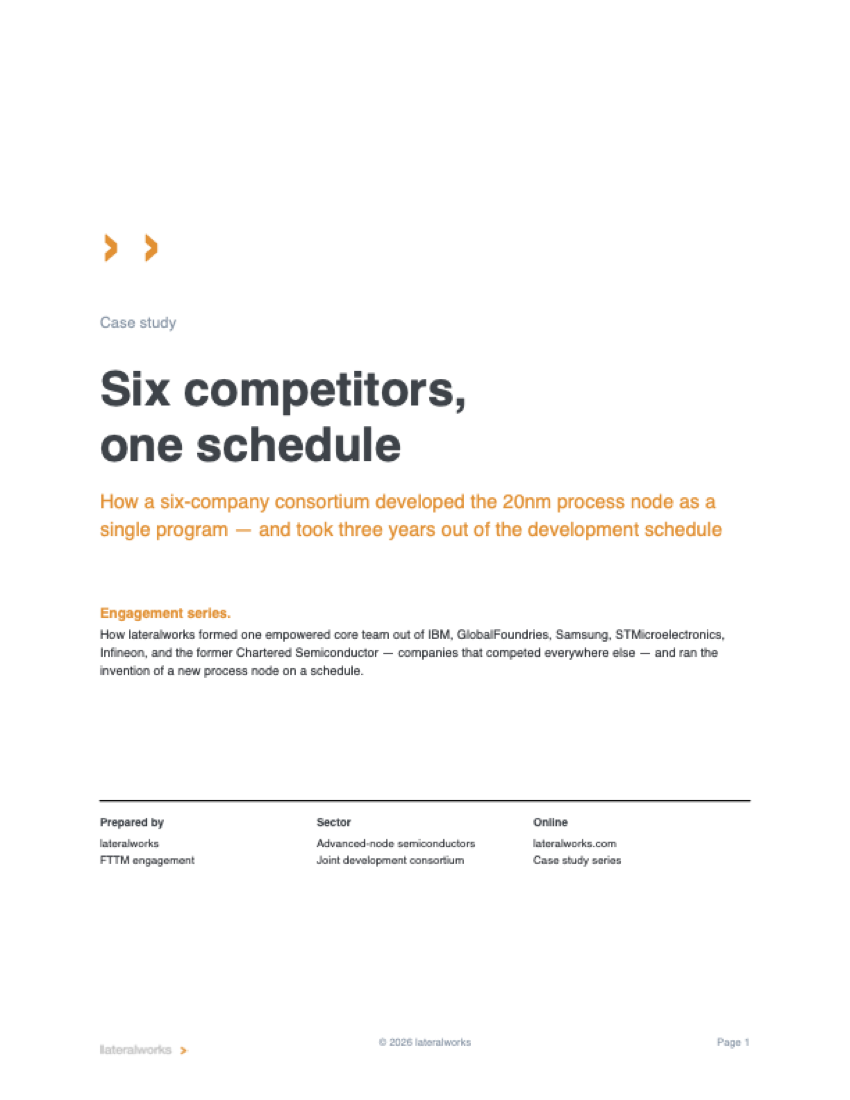
Cover of Six competitors, one schedule
Client Projects·Case study·Advanced-node semiconductors

Six competitors, one schedule

How a six-company consortium developed the 20nm process node as a single program — and took three years out of the development schedule

Core thesis. Invention does not have to arrive on its own clock. When the learning cycles that produce it are named, scheduled, resourced, and run concurrently — and when one person owns each decision — a research program behaves like a delivery program. That is managed innovation: scheduled invention. On 20nm it was worth three years.

July 6, 2026·22 pages
Cover of Prioritizing through the crash
Client Projects·Case study·Semiconductor equipment

Prioritizing through the crash

Portfolio modeling and project selection at Applied Materials, 2007–2009

Core thesis. A project portfolio is a standing decision about where scarce resources go. The organizations that navigate downturns best are the ones whose planning survives contact with bad times. A portfolio built on an explicit decision model can be re-run in weeks when the world changes. A portfolio built on accumulated commitments cannot.

July 5, 2026·21 pages
Cover of Lab realignment
Client Projects·Case study·Semiconductor equipment

Lab realignment

How Applied Materials collapsed four labs into two and hit a $20M-a-year savings target on schedule — without ever stopping the business.

Core thesis. The savings were never in doubt; the schedule was. Every quarter of delay cost Applied roughly $5M it would never recover, so lateralworks structured the program so the schedule itself protected the money — built around tools rather than buildings, driven by one repeatable move template, and refreshed weekly so slips surfaced as trends before they became misses.

July 3, 2026·22 pages
Cover of Project Everest
Client Projects·Case study·Grid-scale energy storage

Project Everest

Moving a utility-scale battery maker out of the hardware business, and shipping the first integrated system in twelve months

Core thesis. A hardware company cannot out-price a commoditized, China-dominated supply chain. It can out-integrate it. Everest moved the client off the factory floor and onto the software and data layer, and proved the move on a single product, on time, with a dedicated team that owned one schedule end to end.

July 2, 2026·29 pages
Cover of Project Rubicon
Client Projects·Case study·Solar power electronics

Project Rubicon

A five-engineer team, a microinverter built into the cable, and a working prototype in under six months

Core thesis. The product a team ships is decided long before the engineering is done — by the conditions leadership sets, the customers the team listens to, and the schedule it runs against. Project Rubicon put five engineers in the right conditions, pointed them at a customer-defined target, and reached a working proof of concept in under six months. The parent company chose not to commercialize it. The method still did exactly what it is built to do.

July 1, 2026·36 pages
Cover of Integrating a multi-supplier lunar program
Client Projects·Case study·Aerospace / commercial space

Integrating a multi-supplier lunar program

How lateralworks rebuilt one integrated master schedule and a weekly refresh cadence to put a commercial lunar lander program back on a converging path.

Core thesis. A hardware program split across many subcontractors distributes the work but holds the integration risk in one place, and status reporting can't force it to converge. Convergence comes from a single integrated master schedule that every supplier's work lives inside, refreshed weekly in one room, with the critical path and the cause of every slip tracked to each target.

June 30, 2026·18 pages
Cover of One program, many companies
Client Projects·Case study·Advanced-node semiconductors

One program, many companies

Running a multi-site advanced-node development program as a single, integrated team

Core thesis. When a program depends on many companies, the work is not coordination but integration — building one team, one schedule, and one set of decisions out of organizations that arrive as strangers. The integrator's highest-value output is an early, honest read of the two things that bind the schedule: the maturity of what you inherit and the capability of the partners you depend on.

June 18, 2026·27 pages
Cover of Recovering a worldwide security program
Client Projects·Case study·Networking & security

Recovering a worldwide security program

How lateralworks recovered Cisco's year-late ACS 5.0 program and protected the hardware roadmap that depended on it

Core thesis. A late program rarely recovers because people start working harder. It recovers when the schedule becomes a living instrument the whole team can see and pull on. lateralworks made the gap visible, gave eleven teams ownership of their own end-to-end work, and refreshed and pulled in the plan two and three times a week until the predicted delivery date stopped drifting and started converging on the target.

June 17, 2026·26 pages
Cover of Innovation Accelerated
Client Projects·Case study·Semiconductors

Innovation Accelerated

advanced display fab and technology development

Core thesis. You cannot accelerate a program you do not see. The first job was making the program visible end-to-end — one integrated plan, one core team, one refresh cycle — and then closing the gap one critical-path week at a time.

May 17, 2026·28 pages
Cover of Sony PlayStation
Client Projects·Case study·Semiconductor

Sony PlayStation

The 500K ASIC

Core thesis. When a program demands more than the organization can deliver, the response must be structural. Pick one driving customer, integrate hardware and software workstreams under one empowered core team, and run the planning cadence at a frequency that surfaces gaps before they ossify.

May 13, 2026·23 pages
Cover of Planning in three days, not three weeks
Client Projects·Case study·Semiconductor

Planning in three days, not three weeks

How a chip-development team compressed multi-year program planning from weeks to days, with AI doing 80% of the synthesis and the team scrubbing the rest.

Core thesis. AI-assisted macro planning compresses about 80% of the synthesis work into hours and routes the remaining 20% — judgment, calibration, local context — through the team. On a multi-year stacked-memory program, that split delivered a publishable charter, milestone matrix, and macro schedule in three days against a conventional cycle of three to four weeks.

May 6, 2026·44 pages
Cover of The 12.12.12 pilot line
Client Projects·Case study·Semiconductor

The 12.12.12 pilot line

How Alta Devices recovered an eight-month projected schedule miss and brought the world's most efficient solar cell to manufacturing.

Core thesis. A pilot line on a hard deadline cannot be recovered by the departments running its work streams in parallel — recovery requires one integrated schedule, one weekly cadence, and the full management team in the room. On the Alta Devices program, that combination closed an eight-month projected gap inside an eleven-month planning window.

May 4, 2026·15 pages
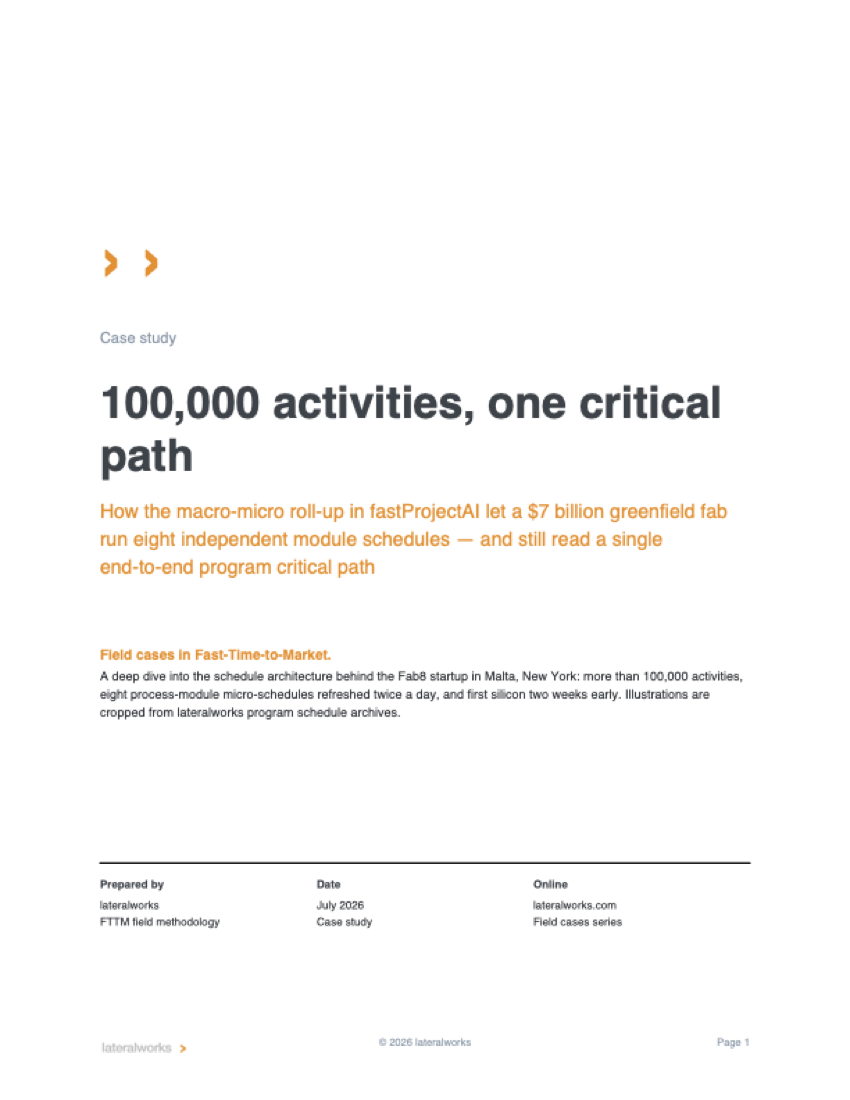
Cover of Building a $7 billion fab in under two years
Client Projects·Case study·Semiconductor

Building a $7 billion fab in under two years

How an empowered core team and integrated master schedule overcame a two-year projected delay

Core thesis. A two-year deficit doesn't close incrementally. It closes when an empowered core team owns the outcome end-to-end, an integrated master schedule serves as the single source of truth, and refresh planning runs at a cadence frequent enough to expose gaps the same day they appear.

May 3, 2026·23 pages
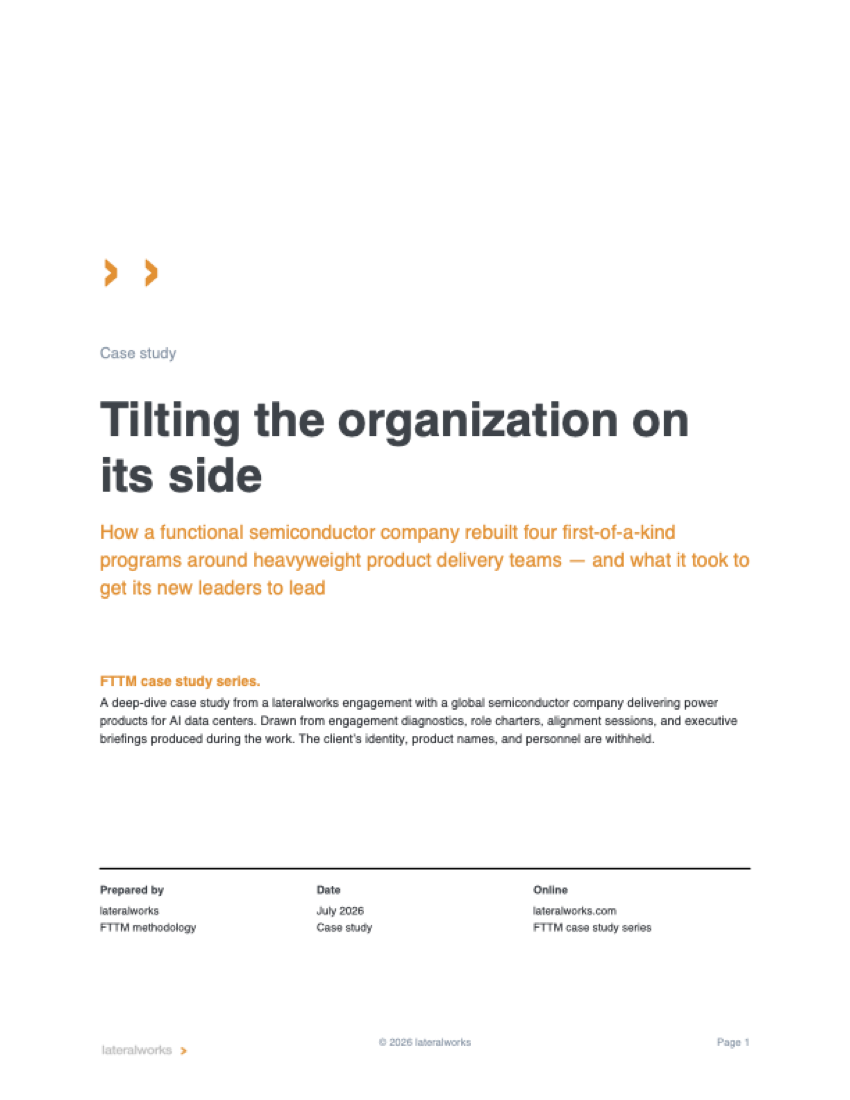
Cover of The schedule mirrors the team
FTTM Coaching·Case study·Semiconductor / AI data-center

The schedule mirrors the team

Why functional project managers build functional schedules — and what it takes to move them

Core thesis. A schedule is the visible artifact of an invisible operating model. When a functional organization adopts cross-functional tools, the organization reshapes the tools faster than the tools reshape the organization. Real change comes from moving the team from lightweight coordination to heavyweight ownership; the schedule will follow.

April 30, 2026·23 pages
Cover of Charles Schwab IT infrastructure rationalization
Client Projects·Case study·IT

Charles Schwab IT infrastructure rationalization

How program structure and portfolio prioritization halved the path to $15M in annual savings

Core thesis. Time-to-savings programs fail when they lack portfolio prioritization, integrated planning, and financial visibility. lateralworks turned a 400-project backlog into a sequenced, measurable execution engine by applying the same program structuring discipline used in time-to-market product delivery, reframed around cost-savings velocity rather than ship dates.

April 15, 2026·20 pages
Cover of Launching Windows CE at startup speed
Client Projects·Case study·Systems

Launching Windows CE at startup speed

How an empowered product delivery team shipped a first-wave handheld PC in 13 months

Core thesis. When the deadline is existential and the work spans multiple companies, the single most important design decision is organizational, not technical. Stand up a ring-fenced product delivery team with end-to-end ownership, governed above the hierarchy, and let an integrated master schedule do the coordination work that committees do too slowly.

February 1, 2026·20 pages

Most case studies we can publish are >10 year old projects. Our current work involves advanced technology at the bleeding edge. We are not able to share these details for obvious reasons.